
Healthcare Employee Engagement Surveys: How to Run Them (and Act on Results)

Updated: Aug 19
Key Takeaways on Healthcare Employee Engagement Surveys
Engagement is a leading indicator: top-quartile hospitals are 4.2x more likely to reach top-quartile patient experience.
Layer the instruments - an annual baseline, quick pulses, lifecycle check-ins, and eNPS each answer a different question.
Design for a 24/7, deskless workforce: 8–10 questions, validated healthcare items, anonymity staff believe in, shift-aware timing.
Distribution drives validity - text-based surveys reach the 70–80% of staff who rarely see email and lift response rates to 45–60%.
Segment by role, unit, tenure, and shift, and treat nonrespondents as a flight-risk signal.
Action is the deliverable: publish a plan within 30 days, make “you said, we did” public, give managers ownership, then re-measure.
What's Actually at Stake When Healthcare Staff Disengage?

Employee engagement is the psychological commitment, enthusiasm, and discretionary effort your staff bring to work each shift.
Satisfaction is something else - a nurse can be content with their schedule and still be quietly checked out at the bedside.
In a hospital, disengagement surfaces in the care itself: skipped rounding, shortcut safety protocols, colder patient interactions, and eventually resignations that leave units running short.
The hard part for leadership is that almost none of this is visible in real time.
Once it registers in turnover reports and patient complaints, the damage is already done and expensive to reverse.
That's the case for engagement surveys.
They're the workforce equivalent of taking vital signs - a way to catch deterioration before symptoms become a crisis.
Hospitals in the top quartile for engagement are 4.2x more likely to land in the top quartile for patient experience - reason enough for engagement to sit beside clinical and financial performance rather than in an HR silo.
Disengaged staff are also far more likely to walk, and few problems cost more than replacing clinical talent.
A survey won't fix any of that on its own.
It tells you where to look - and what you do after it closes matters more than the survey itself.

Which Survey Type Answers the Question You're Asking?
The Annual Engagement Survey: Your Benchmarked Baseline
Think of the annual survey as the yearly physical.
It goes to your entire workforce, covers every driver of engagement, and produces the benchmarked baseline that tells you where you stand against comparable organizations.
That comprehensiveness is its value - and its limitation.
Annual data is stale by the time action planning begins, so treat this survey as the foundation you build on, not the whole program.
The organizations getting the most from listening layer pulses and lifecycle check-ins on top of it.
Pulse Surveys: Quick Reads Between the Big Ones
A pulse survey is a short, recurring check-in - typically 5 to 15 questions - sent monthly or quarterly.
If the annual survey is the physical, the pulse is the wearable tracking vitals between visits.
Its job is to answer one question: is the trend moving, and did the last thing we changed actually work?
A useful design principle here is 70:20:10 - keep about 70% of items consistent so trends hold, use 20% to probe specific engagement drivers, and save 10% for topical questions about whatever is live right now, such as a new staffing model.
Lifecycle Surveys: Onboarding, Stay, and Exit

Lifecycle surveys catch people at the moments when attrition risk peaks - the first 30 and 90 days, key tenure milestones, and departure.
They work like screenings scheduled at known risk points rather than waiting for the annual check-up.
Stay interviews deserve special attention.
These are one-on-one conversations about what keeps someone here, and they happen while the person is still on your payroll.
Exit interviews, on the other hand, have no solid evidence behind them as a turnover fix when used alone.
That gap matters, because 52% of employees who leave voluntarily say their manager or organization could have done something to prevent it.
The information you needed existed - a stay interview is how you get it in time.
eNPS: One Number You Can Trend All Year
The Employee Net Promoter Score asks one question: on a scale of 0 to 10, how likely are you to recommend this organization as a place to work?
Scores of 9 or 10 are promoters, 7 and 8 are passives, and 6 or below are detractors.
Subtract the percentage of detractors from the percentage of promoters and you have your eNPS - above 20 is considered good, above 40 excellent.
The appeal is obvious: a single number that trends cleanly and travels well in a board deck.
eNPS tells you what the temperature is, though, not why it changed - pair it with driver questions before you act on a swing in either direction.
Designing a Survey Staff Can Finish on a Break
Keep It Short - Really Short
Completion rates drop sharply once a survey passes the five-minute mark on a phone, and every added question cuts completion by roughly 10–15%.
For a pulse, that puts the practical ceiling at 8–10 well-crafted questions.
This is harder discipline than it sounds, because every stakeholder wants their two questions included.
Hold the line anyway.
One large health system cut its engagement survey from 45 questions down to six highly actionable items and now runs it three times a year.
Save the long questionnaire for the once-a-year census, where depth is the point.
Use Validated, Healthcare-Specific Questions

Generic corporate survey items miss the realities of clinical work, and your staff will notice when a question clearly wasn't written with a med-surg unit in mind.
Choose validated, healthcare-specific instruments instead - RN engagement items approved for Magnet designation, for example, or safety-culture questions vetted by national quality bodies.
Validated items let you benchmark against organizations that look like yours, by facility type and role, and they keep your trend lines honest - provided you resist rewriting core questions every cycle.
Consistency is what makes a trend mean anything.
Make Anonymity Something Staff Can Believe In
If staff suspect their answers can be traced back to them, you won't get honesty.
You'll get silence, or worse, polite fiction.
Candor depends on protection people believe in, which is why independent administration and minimum reporting-group sizes matter - never report results for groups so small that individuals become identifiable.
Say the protections out loud at every launch - who sees the data and at what level of aggregation - and don't assume staff remember them from last year.
And treat a perceived breach as seriously as a real one, because a single story about a manager confronting someone over a survey answer will poison response rates for years.
Schedule Around Shifts, Not Office Hours
A survey window built for people at desks between 9 and 5 excludes a large share of a hospital.
Keep the window open long enough to cover nights and weekends, vary the times invitations and reminders go out, and steer clear of peak clinical hours.
The design target is simple: someone should be able to complete the survey on a personal phone, in a break room, at 3 a.m.
Give people a heads-up before launch too - through managers, huddles, and the channels staff already use.
A survey that arrives expected gets treated as legitimate.
One that appears out of nowhere gets ignored, or distrusted.
Distribution Decides Whose Voice Gets Heard
The Deskless Majority Problem
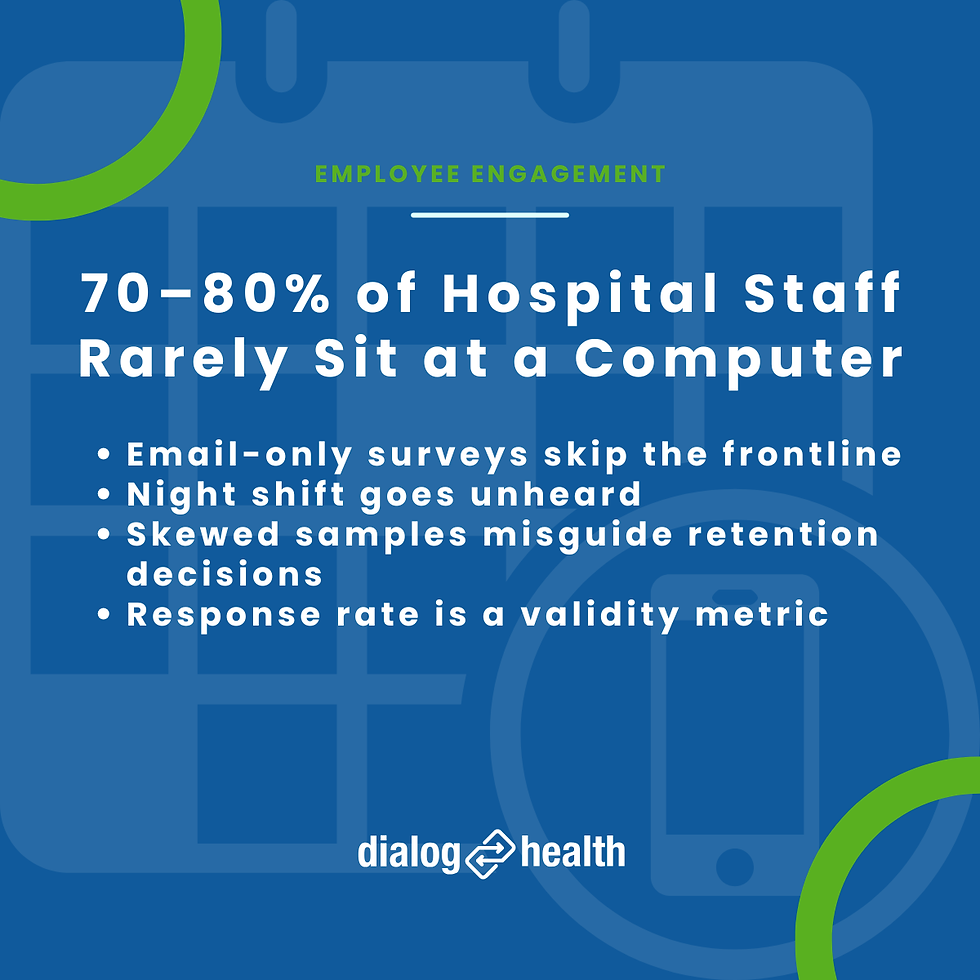
Between 70% and 80% of hospital staff are deskless - rarely at a computer during a workday, often without a corporate inbox or intranet access at all.
Send your survey by email alone and you've systematically under-sampled night shift, environmental services, techs, and aides - precisely the voices carrying the most attrition risk.
What comes back looks like data, but it's really the opinion of whoever was easiest to reach.
That's why response rate is a validity metric, not a vanity metric.
A skewed sample means you're making retention decisions for the people you least understand, based on feedback from the people you understand best.
Why Text Reaches the Staff Email Misses
Text messaging solves the reach problem because it runs on the phone already in every staff member's pocket.
No corporate email address, no app download, no intranet login.
Surveys sent by text with a direct link achieve 45–60% response rates, while email invitations often languish in the single digits.
The reach side of this is something we've seen firsthand: when a tsunami warning hit the Oregon coast in late 2024, Southern Coos Hospital used our platform to text every employee - and reached 99% of them within minutes.
The pipe that delivers the survey invitation also carries the reminders, and later, the updates that show staff their feedback went somewhere.
Dialog Health's two-way texting supports staff pulse surveys directly, segments messages by role, location, or language, and uses trackable links that show which groups still haven't responded.
Add QR codes in break rooms and you've covered the workforce email never could.
What Does a Good Response Rate Look Like?
As a working benchmark, 60% is widely treated as the floor for representative results, and a strong census can clear 80%.
Large health systems realistically land in the 70–80% band; smaller organizations should aim higher still.
The overall number isn't the real test, though.
Judge response rates segment by segment, because a healthy overall figure can hide a night shift responding at half the rate of everyone else.
And when one role group consistently lags, resist the conclusion that those employees don't care.
A lagging segment almost always means the channel isn't reaching them - fix the distribution before you question the workforce.
Segment the Results Before You Act on Them
A single organizational average is the least useful number your survey produces.
Day, night, and weekend shifts often behave like three different hospitals, and results that look fine in aggregate can hide a unit in real trouble.
Before you plan anything, cut the data by role, unit, tenure, shift, and generation.
Pay special attention to early-tenure clinicians.
Engagement tends to bottom out in the first few years on the job, which makes newer clinicians your highest-risk cohort and the natural target for onboarding pulses and stay interviews.
Then look at who didn't answer, because silence is data too.
Nonrespondents are nearly twice as likely to leave within a year - 26% versus 15% for staff who completed the survey.
A quiet unit isn't a content unit.
One caution: keep honoring minimum group sizes even here - analysis granular enough to identify individuals undoes the anonymity the program depends on.
Closing the Loop: Turning Results Into Visible Action
Share Results and a Plan Within 30 Days
Speed is the first credibility test after a survey closes.
Get findings in front of executives within four weeks, publish results to staff alongside a time-bound action plan within 30 days, and post progress updates on a 30-day rhythm after that.
Tell people what you heard, what will change, what won't change - and why.
Staff are more reasonable than leaders tend to assume; they don't expect every problem solved, but they do expect a straight answer.
Keep the plan narrow, too.
Pick two to four priorities and finish them, because sweeping culture initiatives that stall do more damage than modest fixes that land.
The payoff is well documented: organizations that act within that first month see 28% higher engagement and 19% lower turnover within 18 months.
"You Said, We Did" - Make the Follow-Through Public
Here's the uncomfortable number: only 8% of employees strongly agree their organization acts on survey results.
That's the single biggest failure point in engagement programs - not bad questions, not low response rates, but silence after the data comes in.
Running a survey and then going quiet is worse than never asking, because it turns a lack of listening into proof that speaking up changes nothing.
The antidote is a public "you said, we did" habit: connect specific feedback to specific changes, name the owner, give the date, and repeat it on a cadence staff can see between surveys.
Report outcomes rather than activity - "cut onboarding time from 21 days to 14," not "formed a committee."
Remember that follow-through has the same distribution problem as the survey itself; an update that only lives on the intranet reaches nobody on night shift.
One of our clients, Lovelace Health System, used texting to keep roughly 3,600 employees informed and supported through the first two weeks of the COVID-19 crisis - more than 46,000 messages - and credited the steady stream of updates with lifting staff morale.
When your channel reaches every pocket, follow-through gets heard.
Give Managers Ownership of the Action Plan
Organization-wide findings turn into local change through managers, or they don't turn into change at all.
Make ownership explicit.
Executives take the systemic items - staffing levels, pay, safety investments - while unit managers own the local fixes, and both lists are public.
Then tie action-plan completion to manager performance reviews.
That last step separates programs that produce change from programs that produce reports, because it converts follow-through from a favor into part of the job.
Give managers their unit's results quickly and in a form they can use, or none of this happens.
One home-based care organization that ran its program this way cut turnover from 20% to 11% while lifting staff confidence that feedback leads to change.
Re-Measure to See If It Worked
An action plan is a hypothesis until you test it.
Run a follow-up pulse against the areas you acted on, compare, adjust, and go again - plan, act, re-measure, repeat.
It's Plan-Do-Study-Act applied to your workforce, and it deserves the same discipline you'd give a clinical quality program: named owners, defined targets, a fixed cycle.
Treat the survey item about whether improvements followed the last survey as your program's own KPI, tracked year over year.
And be patient with trust.
After a stretch of surveys that led nowhere, staff typically need two to three consecutive cycles of visible follow-through before they believe the program again - and before their answers get fully honest.
The Mistakes That Quietly Kill Survey Programs
Most survey programs don't fail loudly.
They erode, usually through a handful of familiar mistakes:
Surveying too often without acting in between, which teaches staff that answering is pointless
Asking generic questions that ignore clinical realities
Letting confidentiality get fuzzy - or letting staff believe it has
Chasing ten priorities at once until initiative fatigue sets in and nothing finishes
Burying results that turned out uncomfortable, the most damaging mistake on the list
These mistakes compound.
Every cycle of silence makes the next dataset thinner and less honest, steadily degrading the very instrument you're relying on to manage workforce risk.
The cost shows up in the numbers: in a single recent year, healthcare workers' belief that surveys lead to improvements dropped 12.4 points.
The fix isn't complicated, even if it isn't easy.
Ask less than you're tempted to, protect anonymity without exception, act fast on a short list, show your work, and measure again.
Run it that way and the survey stops being an annual HR ritual.
It becomes what it was always meant to be: the earliest warning system you have for the people who deliver your care.
Put Your Next Pulse Survey in Every Pocket
Everything you just read comes down to two problems: reaching your whole workforce and proving you heard them.
Dialog Health solves both: a HIPAA-compliant, two-way texting platform that puts pulse surveys, trackable links, and “you said, we did” updates on every staff phone - no corporate email required.
Our clients have seen:
99% of hospital employees reached within minutes
78% response rate on an employee enrollment campaign
83% survey response rate by text
Curious what that looks like for your team?
Fill out this quick form and one of our healthcare communication experts will schedule a brief 15-minute video call.


