
How to Reduce Call Center Costs in Healthcare: 6 Practical Ways

Key Takeaways on How to Reduce Call Center Costs in Healthcare
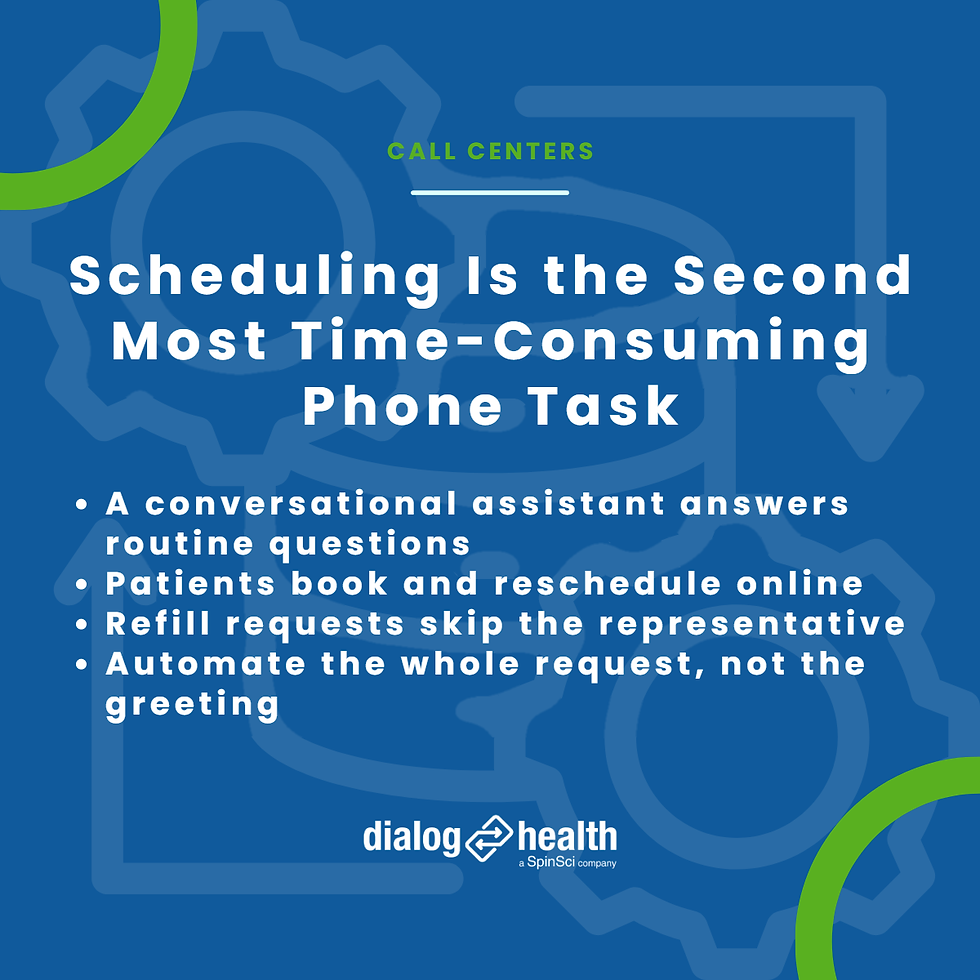
Self-service tools remove the cheapest calls first: hours, directions, password resets, refills, and scheduling, which ranks as the second most time-consuming phone task.
HIPAA-compliant two-way texting prevents inbound calls with reminders and confirmations, turns outbound dialing into automated campaigns, and routes exceptions by keyword reply.
Visual IVR and skills-based routing shorten queues and cut transfers, while pre-call verification takes the identity check off agent talk time.
Predictive staffing and a one-to-many messaging ratio change how many agents a peak needs.
A centralized knowledge base and real-time agent assist lift first-call resolution, and every 1% gain cuts operating costs by about 1%.
Move Routine Requests to Patient Self-Service Tools
Every conversation about call center costs ends up in the same place: the calls that never needed an agent.
Clinic hours, directions, accepted insurance plans, and forgotten portal passwords are the cheapest calls to remove, and a conversational assistant on your website or patient portal can answer them around the clock without anyone picking up.
Scheduling is the bigger prize.
In a recent poll of practice leaders, scheduling ranked as the second most time-consuming phone task, behind only eligibility and prior authorization.
Let patients book, reschedule, and cancel through the portal or app, and a large share of that volume leaves the queue for good.
The same goes for prescription refills.
Connect an automated phone menu or the patient app to your pharmacy system so a refill request never reaches a representative.
One rule keeps these tools from becoming a false economy.
Automate the whole request, not just the greeting.
A tool that collects the details and then hands the call to an agent saves nothing.
Start with the rule-bound requests you already have documented, and decide up front what still goes to a person.
Even a confirmation answered with a single character, or a scheduling link opened from a text, is self-service on a channel patients already read.
Put HIPAA-Compliant Two-Way Texting to Work on Call Volume
A large share of inbound calls exist because patients are missing information.
Do I have an appointment Tuesday, what do I need to bring, and can I move it?
Automated appointment reminders, prep instructions, and confirmation requests answer those questions before the phone rings, and a confirmed appointment means fewer no-show calls later.
The outbound side is where the labor hides.
These campaigns are usually dialed one patient at a time, and most attempts end in voicemail:
recall outreach
referral follow-up
post-visit check-ins
balance reminders
Run them as automated text campaigns instead.
Your staff then phone only the patients who reply with a problem or don't reply at all.
You can also flip outbound into inbound: a text that says "call us at this number when you have a moment" produces one short, planned call at a time the patient chose, instead of a chain of missed calls and callbacks.
Keyword replies sort the rest.
Reply 1 for a nurse, 2 for billing, and the follow-up lands with the right person before anyone dials.
Appointment details, results, and balances are protected health information, so the platform needs a signed business associate agreement, encryption, opt-in and opt-out handling that satisfies consent rules, and an audit trail.
Personal phones and consumer messaging apps don't qualify.
One more test before you buy.
The platform should connect to your scheduling system and EHR so confirmations and replies post automatically.
Otherwise you've added one more screen for agents to juggle, and that raises handle time instead of lowering it.

Replace Legacy Phone Menus with Smart IVR and Routing
Old phone trees are expensive in a way that never shows up on the phone bill.
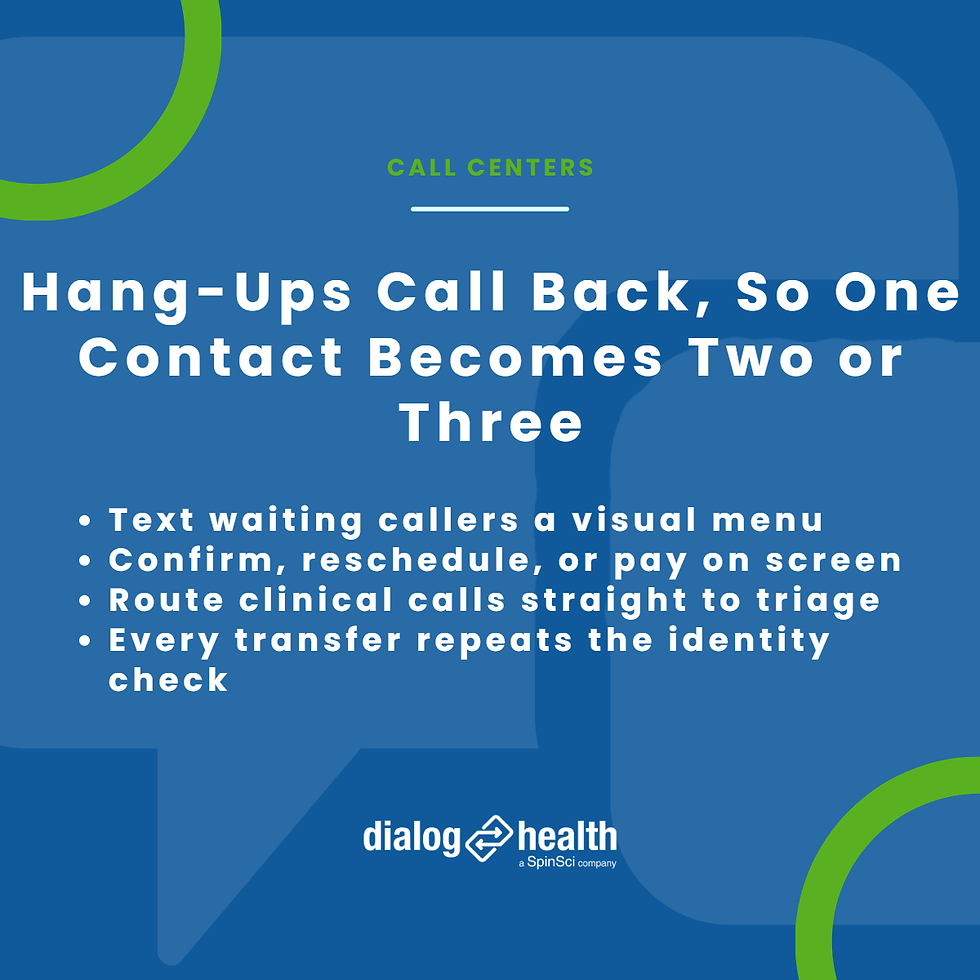
Callers wait, a share of them hang up, and most of those hang-ups call back, so one contact becomes two or three.
Visual IVR offers callers a way out of the queue.
While they wait, the system sends a text with a link to a web-based menu where they can confirm, reschedule, pay a balance, or find directions on screen.
Every caller who takes that path shortens the voice queue for the ones who need a person.
Routing is the other half.
Skills-based routing sends clinical questions straight to nurse triage and billing questions straight to billing on the first attempt.
Transfers are a cost multiplier, because each one repeats the greeting, the identity check, and the patient's explanation.
Route on context, meaning who is calling and why, rather than on a generic menu, and average handle time drops along with the transfer count.
Verify Patient Identity Before the Agent Picks Up
Every call starts the same way: name, date of birth, insurance details, sometimes an address.
It's necessary, it's repeated thousands of times a day, and it's agent talk time that produces nothing the patient called for.
Pre-call verification moves that step into the queue.
An automated voice assistant confirms identity while the patient waits, so the agent starts the conversation already knowing who's on the line.
The second piece is computer telephony integration, which passes the verified profile straight to the agent's screen.
No re-keying, no asking the patient to repeat what they just told the system, and less after-call work because the record is already open.
Texting has no role in this step, and that's fine.
Is Your Staffing Model Built Around Real Call Patterns?
Labor is the largest line in a healthcare contact center budget, which makes staffing precision the lever with the most dollars behind it.
Start with predictive staffing.
Your historical volume already shows the peaks: Monday mornings, the day after a holiday, open enrollment weeks.
Build schedules around those patterns, because an overstaffed quiet afternoon burns payroll and an understaffed peak creates abandonment, callbacks, and overtime.
For spikes you can predict but can't staff permanently, an overflow pool of part-time or partner agents beats adding headcount you'll carry all year.
Then look at the ratio.
A voice agent handles one patient at a time.
An agent working text and chat can hold several conversations at once, because patients answer in their own time and no one sits on hold.
Shifting routine volume to that channel changes the math on how many people a peak needs.
Your messaging channel also generates data your forecast should include: delivery rates, reply rates, when replies come in, and which messages still trigger a phone call.
That last one tells you where the next round of automation belongs.
Give Agents One Knowledge Base and Real-Time Help
Healthcare agents juggle insurance rules, clinical terminology, and provider schedules that change without notice.
When that information lives in binders, shared drives, and someone's memory, calls run long, get transferred, or end with "I'll call you back."
A centralized knowledge base fixes the search problem.
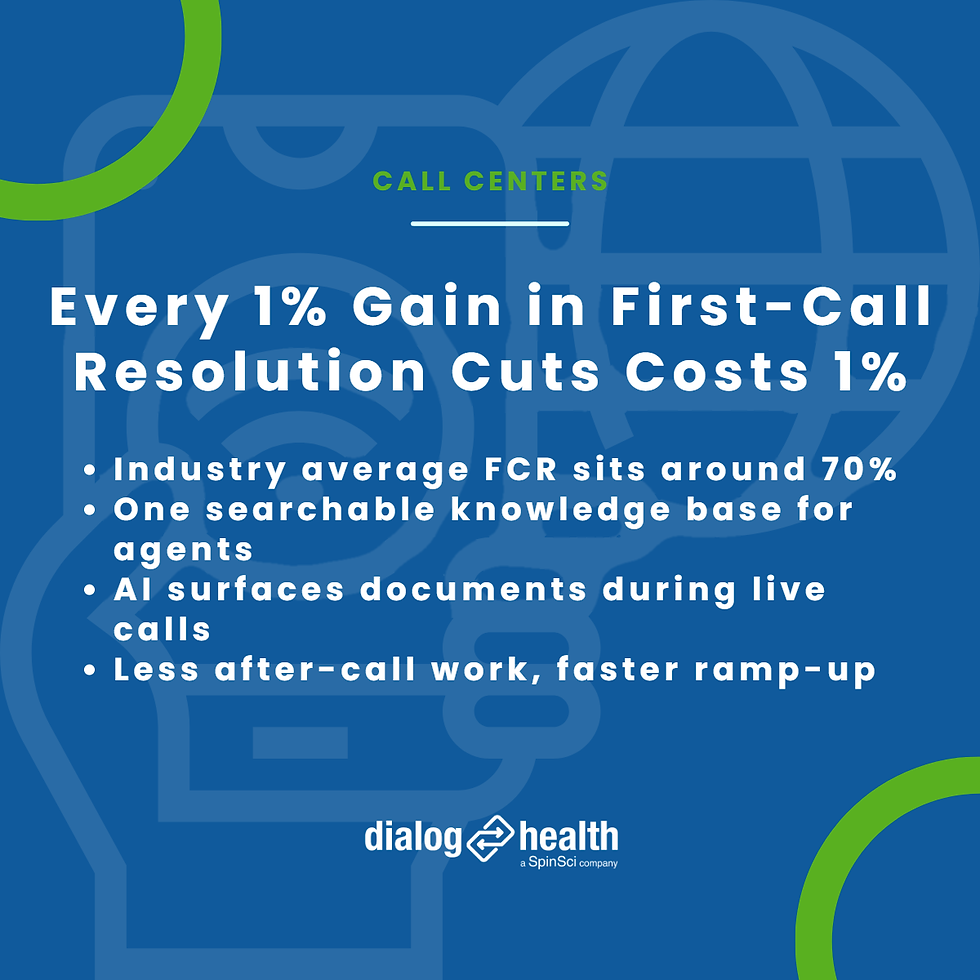
Provider directories, billing rules, and script guidelines sit in one searchable place, so agents resolve more on the first contact.
That matters more than it sounds.
Every 1% improvement in first-call resolution cuts operating costs by about 1%, and the industry average sits around 70%, so most centers have room.
Real-time agent assist takes the next step.
An AI tool listens to the live call and surfaces the relevant document or the next-step compliance checklist while the agent is still talking.
Notes get drafted as the call happens, which trims after-call work, and new agents reach full speed sooner because the answer shows up on screen instead of in a training manual.
Take the Routine Calls Off Your Agents' Plates
Most of what you just read comes down to one question: which of those calls could a text handle?
Dialog Health is the HIPAA-compliant two-way texting platform built for healthcare. It automates reminders, confirmations, and follow-ups, routes replies to the right person, and connects to your existing systems.
Documented results:
92% reduction in post-op phone calls
97% contact center reach rate
200%+ higher response rate than phone calls
Fill out this quick form and one of our healthcare communication experts will reach out to schedule a brief 15-minute video call at your convenience.
We've done this hundreds of times with healthcare organizations just like yours, and you'll get all the information you need.
P.S. No hard sell. We'll tell you which calls texting can take and which it can't.


