
NPO (NOTHING BY MOUTH) REMINDERS
NPO SMS REMINDERS THAT REACH PATIENTS AND REDUCE SAME-DAY SURGICAL CANCELLATIONS
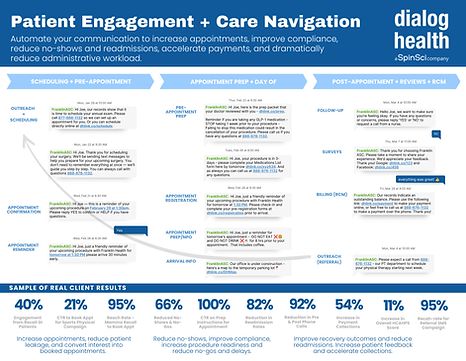
Verbal instructions get forgotten. Paper packets get lost. A text gets read within minutes. Dialog Health's two-way texting platform automates the entire pre-procedure journey: Confirmation → Appointment Reminder → Prep Reminder → NPO Reminder → Completed Procedure - so patients arrive fasted, prepped, and ready, and fewer slots sit empty.
Fewer gaps in the procedure schedule
More patients arrive fasted and prepped
Drastically fewer pre-op phone calls
66% fewer same-day cancellations - real client results
Real-time analytics - now who saw the NPO instructions
Every patient, their preferred language

Trusted by leading healthcare organizations.


A CANCELLED CASE IS A ROOM THAT CAN'T BE REFILLED AND A PATIENT WHOSE CARE JUST GOT DELAYED
Same-day cancellations are one of the most expensive, most preventable problems in procedural care. A patient eats breakfast before a colonoscopy, skips the prep, or forgets to hold a medication - and the case is gone. The room sits idle, staff and anesthesia are already paid for, and the slot can't be backfilled on a few hours' notice. The cause is rarely defiance. It's communication: instructions given verbally or on paper at booking are forgotten by the time they matter.

12.4% average same-day cancellation rate across 329,784 cases at 40 U.S. hospitals
40–80% of medical instructions are forgotten immediately, and almost half of what's remembered is wrong
$36+ per minute what an operating room costs whether the case happens or not

WHY TEXTING BELONGS AT THE CENTER OF PRE-OP PREP
Protect Procedure Volume
Automated confirmations and reminders keep the schedule full. When a patient needs to reschedule, you hear early - with time to fill the slot.
Customized by Procedure & Patient
Dynamic tags and smart targeting tailor every message - colonoscopy vs. cataract, morning vs. afternoon, GLP-1 or not - so instructions are always right.
NPO & Prep Instructions That Get Read
Fasting cutoffs, prep steps, and medication holds arrive as a text timed to each procedure — not buried in a packet or behind a portal login.
130+ Languages, Automatically
The AI Translator handles inbound and outbound messages in real time, so language is never the reason a patient arrives unprepared. No app required.
True Two-Way Conversations
Patients reply with real questions ("Is black coffee okay?") and your team answers in the same thread - before confusion becomes a cancellation.
Read Receipts & Real-Time Analytics
AnalyticsPRO shows who was delivered, who read, who clicked the prep link - and who needs a personal follow-up call.
CASE STUDY

REDUCE CANCELLATIONS
REAL RESULTS
East Valley Endoscopy Reduced Same-Day Cancellations by 66% With Dialog Health
East Valley Endoscopy, an AMSURG GI and endoscopy center in Mesa, Arizona, was averaging about 16 patient cancellations a month - driven mostly by NPO non-compliance, no-shows, and poor prep. Every one meant an idle procedure room, a slot no one could backfill, and a patient whose colonoscopy or EGD got pushed out.
Using Dialog Health's console, the center built its own four-message, two-way workflow: a 10-day confirmation, 5-day reminder, 3-day compliance reminder, and 2-day appointment + NPO reminder. Patients could confirm or flag a conflict by text, so openings got filled earlier. The goal, tracked through a QAPI study, was a 10% reduction in same-day cancellations. They got 66%.
66% fewer same-day cancellations
63% better NPO compliance
56% fewer no-shows
89% fewer prep issues
ANALYTICS AND REPORTING
ANALYTICSPRO, REAL-TIME, ACTIONABLE DATA
See which NPO and prep messages were delivered, which were read, which prep links were clicked, and which patients replied. Real-time reporting tells your pre-op team exactly where to spend a personal phone call - on the handful of patients who haven't engaged - instead of dialing everyone. Track results against a QAPI-style reduction goal and report ROI with hard numbers.
.png)

BUILT FOR THE TEAMS RESPONSIBLE FOR FILLING THE SCHEDULE AND GETTING PATIENTS PREPPED
Dialog Health's HIPAA-compliant platform scales from a single center to enterprise health systems:
Ambulatory surgery centers (ASCs) - protect every slot on the procedure schedule
GI & endoscopy centers - prep adherence and NPO compliance at scale
Hospitals & surgical services - enterprise-wide pre-op communication
Specialty & physician practices - procedure-specific prep for any service line
FQHCs - accessible, multi-language pre-op outreach
Typical users: ASC administrators, surgical services directors, perioperative and pre-op nurse managers, practice managers, schedulers, and care coordinators.
FREQUENTLY ASKED QUESTIONS
What are NPO reminders, and why does texting work so well for them?
NPO ("nil per os," or "nothing by mouth") reminders tell patients when to stop eating and drinking before a procedure so they can safely receive anesthesia or sedation. Texting works because it's read almost immediately - SMS open rates run around 98% and most texts are read within three minutes - while paper handouts get misplaced and portal messages go unseen. A timed text meets the patient the night before and the morning of, when the instruction actually matters.
When should NPO and prep reminders be sent before a procedure?
Best practice is a short sequence, not a single message. In our AMSURG case study, the ASC sent four texts - 10 days, 5 days, 3 days, and 2 days out - with the final message reinforcing NPO compliance. Because ASA fasting guidance sets different cutoffs (clear liquids up to 2 hours before, a light meal 6 hours, and heavier or fatty meals 8 hours), a final reminder timed to each patient's arrival keeps the fasting window accurate for morning versus afternoon cases.
How is two-way texting better than one-way reminders, robocalls, or the patient portal?
One-way blasts and robocalls can't answer "Can I take my blood-pressure pill with a sip of water?" - so an unsure patient guesses, and sometimes guesses wrong. Two-way texting lets patients reply in the same thread and get a real answer from your staff, turning a would-be cancellation into a prepped patient. Portals require a login patients rarely remember; a text doesn't.
What happens when a patient replies with a question or says they can't comply?
The reply lands in a single conversation thread your team can pick up, using pre-written responses or free-hand replies. If a patient reports they ate, took a medication they shouldn't have, or couldn't complete prep, you find out before the day of service - so you can advise them, reschedule safely, and offer the slot to another patient.
Can we customize instructions by procedure, anesthesia type, or GLP-1 status?
Yes. Dynamic personalization tags, custom fields, and smart targeting let you tailor messages - colonoscopy bowel prep vs. bariatric fasting, sedation vs. general anesthesia, GLP-1 vs. no GLP-1. You compose the content and the rules; the platform sends the right message to the right patient at the right time.
How should we handle GLP-1 (Ozempic, Wegovy, Mounjaro) hold instructions?
GLP-1 medications slow gastric emptying and can raise aspiration risk, and clinical guidance has evolved - so the safest approach is to text your facility's specific protocol to the right patients at the right time. Dialog Health lets you flag GLP-1 patients and send a dedicated hold-instruction message (with a link to your prep packet) days ahead, then reinforce it closer in. The platform delivers your clinical policy consistently; it does not set clinical guidance.
Is texting patients about their procedure HIPAA-compliant?
Yes - when it's done correctly, and Dialog Health is built for it. From hosting and storage through processing and transmission, the platform adheres to HIPAA, SSAE, TCPA, CTIA, and SOC II standards. Following the "minimum necessary" principle, a compliant NPO reminder references the appointment and instructions without exposing sensitive clinical detail in the message itself.
What about TCPA, patient consent, and opt-outs?
Pre-op and NPO reminders are treatment communications, which under the TCPA's healthcare treatment provisions generally require prior express consent - typically satisfied when a patient provides their mobile number for that care relationship - rather than the stricter written consent reserved for marketing. Every program includes clear opt-out language (e.g., "Reply STOP to opt out"), and Dialog Health tracks opt-ins and opt-outs at the patient level. As of the FCC's 2025 rule, patients may revoke consent by any reasonable means, and those requests are honored promptly.
Will it integrate with our EHR, practice management, and ASC systems?
Yes. The platform is integration-agnostic and designed to enhance the systems you already use, including Epic, Cerner, Greenway, ModMed, NextGen, Meditech, and Athenahealth, plus ASC platforms such as SIS Complete, Provation, and HST. It supports CSV, HL7, XML, and JSON over UI, sFTP, or Web API to keep schedules and contact details in sync.
Is this different from the reminders our EHR portal already sends?
Usually, yes. Native EHR reminders are typically one-way notifications. The differences that matter for NPO prep are what happens on a reply, whether a cancelled slot can be surfaced and refilled, whether you can run different cadences per procedure without a support ticket, and whether messages can carry translated content, trackable links, and digital forms. If your native tooling already does all of that well, use it - if not, Dialog Health adds it.
Can messages be sent in languages other than English?
Yes. The AI Translator supports 130+ languages with medical-terminology awareness, translating both outbound instructions and patients' inbound replies in real time. Staff compose in English; patients read and respond in their preferred language - no app required.
Does this replace our pre-op nurse phone calls?
It reduces them dramatically, not eliminates them. Automating confirmations, prep, and NPO reminders means your nurses stop dialing every patient and instead focus their calls on the few who haven't engaged or who flagged a problem - exactly the patients who most need a human conversation. Dialog Health clients have reported up to a 92% reduction in pre/post-op calls.
How do we measure ROI and cancellation reduction?
Start the way East Valley did: set a baseline cancellation rate, define a target (they chose 10%), and track results through a QAPI-style study using AnalyticsPRO's delivery, read, click, and reply data. Tie the reduction in same-day cancellations to protected procedure revenue - East Valley estimated roughly $10,000/month in protected revenue.
How long does implementation take, and how much staff effort is involved?
It's fast. Dialog Health is cloud-based - no hardware, no app - and the self-service console lets your team build automated workflows from best-practice templates without coding. East Valley set up its own campaign. A client success team guides implementation and go-live.
What does it cost?
Pricing is tailored to your organization's size and use case. The best next step is a quick, no-pressure demo where we map the platform to your pre-op workflow and cancellation numbers.
trusted by individuals and teams at the world's best companies


