
How Two-Way Texting Supports RCM in Healthcare

Updated: Sep 16
Key Takeaways on How Two-Way Texting Supports RCM in Healthcare
Texting helps at the two ends of the revenue cycle where the patient has to act, showing up, registering, and paying, and does nothing for coding, claims, or denials.
Two-way reminders let a cancellation write back to the schedule so the slot is refilled, and sequences like this have cut no-shows by 53% to 66%.
Texted links to pre-registration, intake, and insurance forms pull that work ahead of the visit and have raised document completion by 225%.
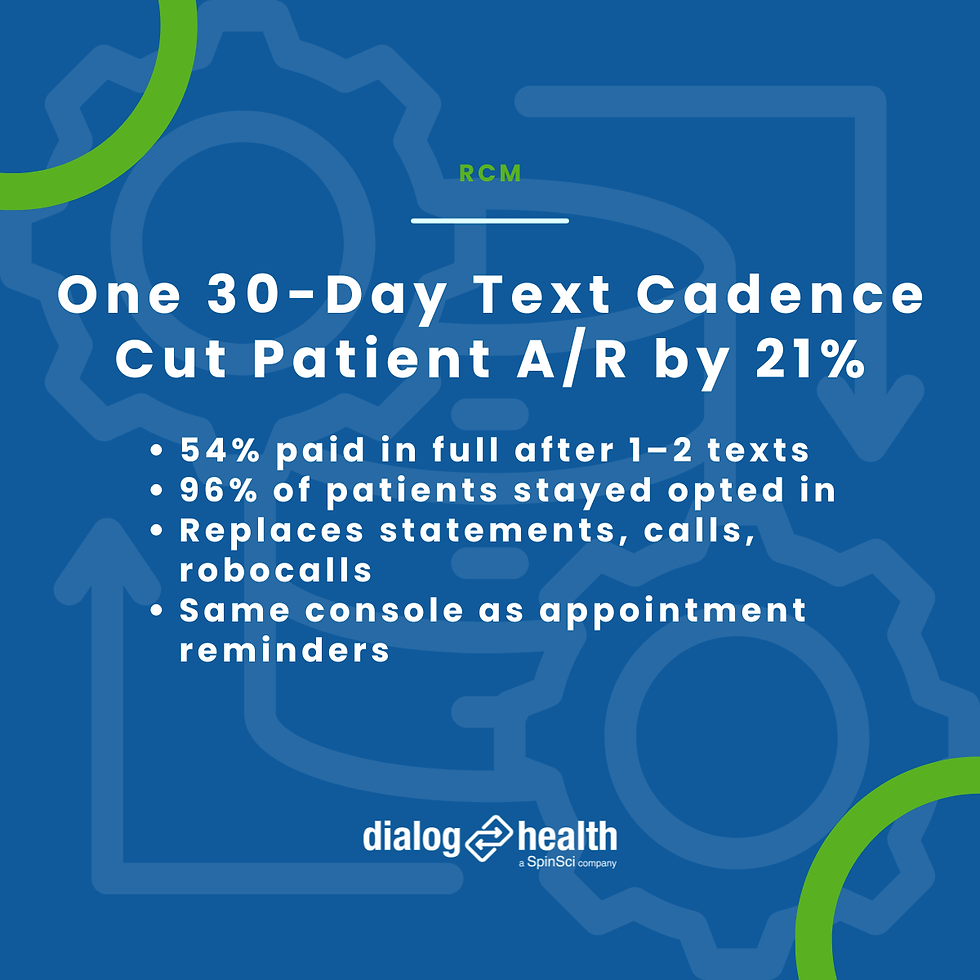
Automated payment reminders on a set cadence replace statements, calls, and robocalls; one of our ASC clients cut patient A/R 21% year over year with 96% of patients staying opted in.
Branded short links that open your existing portal, plus personalization and translation into 130+ languages, are what make patients willing to tap and pay.
A compliant payment text carries only the minimum, never anything clinical, and opt-outs must stop the workflow automatically now that consent can be revoked by any reasonable means.
Delivery and click data turn the aging report into an exception list, and bidirectional integration with your EHR and payment systems keeps balances and reminders in sync.
Next level communication. RCS is the future of verified, branded, and trusted messaging communication.
Which Parts of the Revenue Cycle Can Texting Actually Touch?

Revenue cycle management covers everything from the moment an appointment is booked to the day the last patient balance is paid.
Texting does not help with all of it, and it's worth being clear about that up front.
The middle of the cycle, meaning coding, claim submission, and denial work, runs between you and the payer.
A text message has no role there.
Where texting earns its place is at the two ends of the cycle, where the patient is the one who has to act.
At the front end, that means showing up for the appointment and getting registration and insurance details in on time.
At the back end, it means paying the balance that's left after insurance.
Both depend on reaching the patient, and that's where phone calls and mailed statements struggle.
Most people no longer pick up calls from numbers they don't recognize, and a paper statement takes days to arrive and is easy to set aside.
Texts get opened 95% to 97% of the time.
The two-way part matters as much as the reach.
A one-way blast tells a patient something.
A two-way text lets them confirm, cancel, ask a question, or pay from the same thread, and each of those actions moves money through the cycle.

Protecting Scheduled Revenue Before the Visit
A no-show is revenue you already counted on.
The room was reserved, the staff were scheduled, and the procedure slot went unused.
Two-way reminders protect that revenue in two ways: they make the visit more likely to happen, and they give you time to refill the slot when it won't.
The reminders trigger off your schedule through an EHR integration or a data feed, so nobody queues them by hand.
For a procedure, a typical sequence is a confirmation request ten days out, a reminder at five days, a compliance reminder at three, and an NPO reminder two days before.
Prep instructions and PDFs ride along with those messages, which protects procedure days from cancellations caused by poor prep.
The piece that matters most for revenue is what happens when a patient replies that they can't make it.
That cancellation writes back to your scheduling system, so the slot can be offered to the next eligible patient instead of sitting empty.
Other replies land in a priority inbox where staff answer directly, without a callback.
Reminder sequences that work this way have reduced no-shows by 53% to 66%.
Getting Registration and Insurance Details in Ahead of Time
Every incomplete registration and every unverified insurance card at check-in turns into work later in the cycle.
Claims wait on missing details, staff rework them, and the balance that finally reaches the patient is older and harder to collect.
Texting pulls that work forward to the days before the visit.
A message carries a trackable link to your pre-registration page or a digital intake form, and the patient completes it on their phone from the couch.
Insurance and eligibility details can be collected the same way through a secure link, and so can co-pay verification, so your front desk sees the information before the patient walks in.
Because the links are tracked, you know who has completed the forms and who hasn't.
Staff follow up with the gap, not the whole schedule.
Organizations using texted links for this have seen a 225% increase in pre-appointment document completion.
Learn more about co-pay and insurance verification text messages here.
Payment Reminders That Send Themselves
Back-end collections is where most organizations feel the cost of the old methods.
Mailed statements are slow and expensive, manual calls eat staff hours, and robocalls tend to be ignored.
Automated payment reminders replace all three with texts that go out on their own.
You set a cadence, for example a reminder every 30 days to every patient with an open balance until it's paid, and the workflow runs without anyone touching it.
The messages are built in a self-service console from templates, with no coding.
Each facility can set its own name, callback number, and portal link, and custom data fields drop the patient's own balance into the text.
If you already text appointment reminders, this is the same platform and the same console, so staff aren't learning a new tool.
One of our clients, a national surgery center operator, replaced its robocalls and manual calls with exactly this kind of 30-day cadence across its centers.
Patient A/R fell 21% year over year, and 54% of patients paid their balance in full after one or two texts.
Just as telling, 96% of patients stayed opted in, which answers the worry that payment texts will drive people away.
Staff hours spent on outreach, collections, and data entry dropped, and more patients moved to the online portal.
Why Patients Pay From a Link They Trust
A payment text only works if the patient is willing to tap the link.
People are rightly wary of unfamiliar links that ask for money, so the link itself is part of your collection strategy.
Branded short links solve most of that.
The link uses a custom slug on your own short domain, so it looks like it belongs to your organization rather than a random string of characters.
It opens the payment portal you already have.
There's no new portal to stand up and nothing for the patient to download.
They tap, see their balance, and pay.
For patients who'd rather pay by phone, the same text carries a number to call.
Personalization does the rest of the trust work.
The text names your practice and uses the patient's first name, and if English isn't their first language, they get the message in a language they can read.
You write one template in English, and the platform translates it into more than 130 languages with an understanding of medical terms.
Multi-language and personalization together have raised response rates by 380%.
The same link approach works for financial assistance resources too, so a patient who can't pay in full still has somewhere to go from the text.
If you want to take it to the next level - use RCS communication. This is the future of mobile communication. Verified, trusted and Branded. RCS for healthcare. Dialog Health is leading the way. Contact us today - info@dialoghealth.com

What Happens When a Patient Texts Back About a Bill
Send enough payment reminders and you'll get replies.
Some patients dispute the amount, some say they've already paid, some ask about a payment plan, and some can't get into the portal.
With one-way texting, those replies go nowhere.
With two-way texting, they land in a priority inbox where billing staff answer in the same thread, and the full message history stays attached to the conversation.
Not every reply needs a person.
Automated keyword responses handle the common ones, such as routing a reply into a callback request or sending portal help, and staff pick up only the messages that need judgment.
This is a better experience on the patient's side as well.
Patients describe a text as less of a hassle and more welcoming than a collection call, and the patient who replies is usually the one closest to paying.
For patients whose bills are handled by someone else, a caregiver or secondary contact can be included on the thread.
Keeping Payment Texts on the Right Side of HIPAA and TCPA
Payment texting sits where HIPAA and the TCPA meet, and both are manageable if the messages are built correctly.
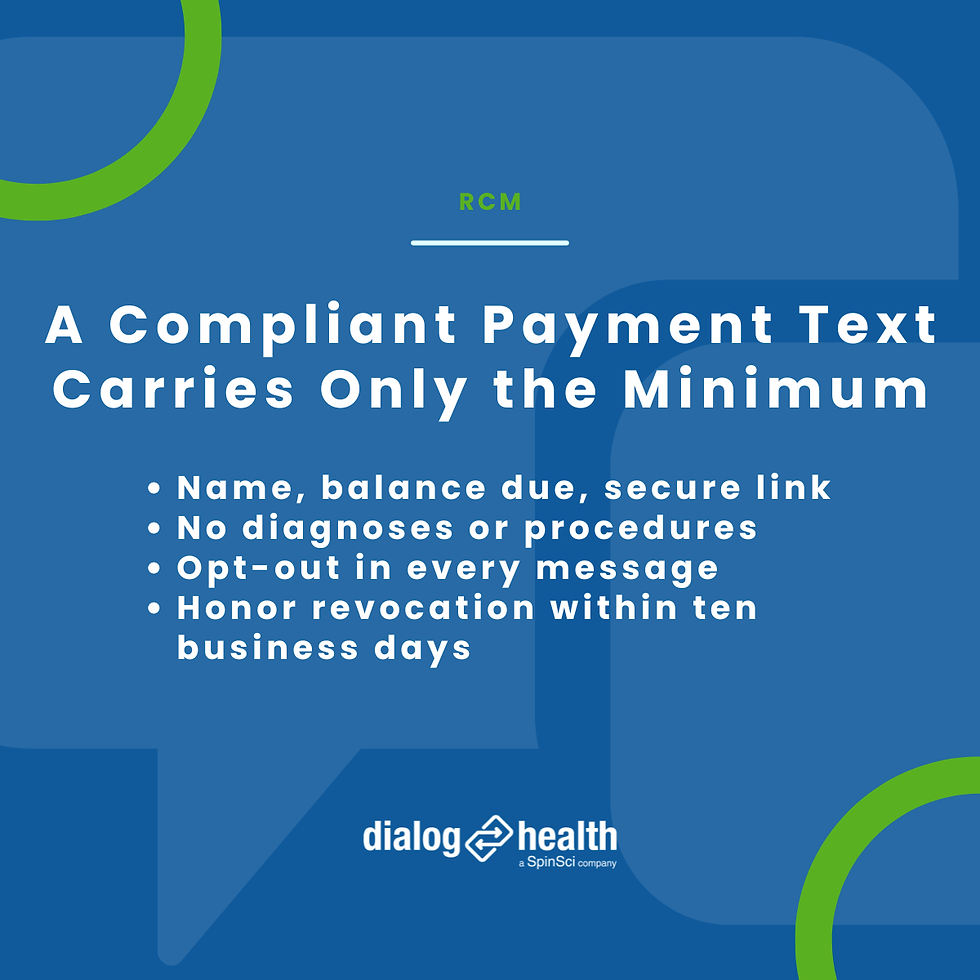
On the HIPAA side, the rule of thumb is that a payment text carries the minimum needed to get the patient to the portal.
That means:
your practice or facility name
the patient's first name
a note that a payment is due
the secure payment link
a support phone number
opt-out instructions
What stays out is anything clinical: diagnoses, procedures, test results, or any detail that reveals a condition.
Templates should use facility names rather than service-line names for the same reason.
On the platform side, look for a signed Business Associate Agreement, messages sent over short codes and 10DLC on tier-1 carriers, and compliance with HIPAA, TCPA, CTIA, FCC, SSAE, and SOC 2 requirements.
Consent is the TCPA piece.
Patients opt in before they receive payment texts, and every message gives them a way to opt out.
Since April 11, 2025, federal rules let a patient revoke consent by any reasonable means, not just a specific keyword, and you have ten business days to honor it.
In practice, that means an opt-out has to flow straight into the workflow and stop the next reminder automatically, without a staff member having to spot it in an inbox.
Using Delivery and Click Data to Decide Who Gets a Call
Every payment campaign produces data as a by-product, and that data is what turns collections from a call list into an exception list.
Real-time delivery receipts show which texts arrived.
Person-level click tracking shows who opened the payment link, who clicked more than once, and who never clicked at all.
Match that against payments received and you have four groups: paid, clicked but didn't pay, didn't click, and couldn't be reached.
Your collections staff call the last two groups and leave the rest alone.
Reports auto-generate after each campaign and export cleanly, which helps when finance leadership asks what the texting program is producing.
Over time, trend views show whether a cadence is actually moving balances, and you can run two versions of a message side by side to see which one gets more clicks.
Opt-in and opt-out metrics deserve a look too.
A rising opt-out rate tells you the cadence is wearing patients down before it shows up as complaints.
Connecting Texting to the Systems Your Revenue Cycle Already Runs On
None of this works if the texting platform can't see your balances, your schedule, and your patient demographics.
That data lives in your EHR or practice management system, and the platform connects to those directly.
Full integrations exist for Epic, Cerner, Meditech, NextGen, athenahealth, ModMed, and Greenway, plus surgery center systems such as SIS Complete, Provation, and HST.
It also connects to RCM platforms, payment systems, and CRMs.
The data moves in whatever form your billing system can already produce: CSV, HL7, or JSON, over a direct upload in the interface, sFTP, or a web API.
The flow runs both ways.
Open balances and appointments trigger messages out, and replies, cancellations, and opt-outs write back, with real-time sync keeping both systems current.
The platform is cloud-based, so there's no hardware to install and no app for patients to download.
For a revenue cycle team, that means the payment reminder that went out at 9 a.m. reflects the balance as of 9 a.m., and the patient who paid at noon doesn't get another reminder next week.
Learn more about our integrations here.
Shrink Patient A/R Without Adding a Single Phone Call
You've just seen where two-way texting fits in the revenue cycle, from kept appointments to closed balances.
Running that by phone and mail means aging A/R, staff on call lists, and statements nobody opens.
Dialog Health is the HIPAA-compliant two-way texting platform behind these workflows.
Documented results:
54% increased cash flow with RCM texting
21% year-over-year drop in patient A/R for a national ASC operator
66% decrease in same-day cancellations
Fill out this quick form and one of our healthcare communication experts will reach out to schedule a brief 15-minute video call at your convenience.
We've done this hundreds of times with organizations like yours, and you'll get everything you need.
P.S. No hard sell. If your collections already work, we'll say so.


