
Must-Read Guide to Rich Communication Services (RCS) for Healthcare Providers

Key Takeaways on Rich Communication Services (RCS) for Healthcare Providers
RCS upgrades texting, it doesn't replace it. It runs over the internet inside the phone's native messaging app with no app download, and falls back to SMS automatically, so the smart play is RCS-first, not RCS-only.
Interactivity is the real advantage. Verified branding, buttons, carousels, and read receipts turn a passive reminder into a task patients finish in the thread.
Adoption has hit critical mass. iOS 18 support and full US carrier coverage mean more than a billion RCS messages now move daily in the US.
The patient-experience wins are concrete: one-tap appointment confirmations, richer pre- and post-op instructions, and tap-to-pay billing.
Verified sender branding builds trust against a backdrop of costly, rising text scams.
Keep PHI off RCS. RCS for Business isn't HIPAA-compliant, so route protected health information through a compliant platform with a signed BAA and use RCS for the non-PHI majority.
Start small. Pilot one non-PHI use case against SMS, measure the lift, then expand where interactivity pays off.
What Is RCS, and How Is It Different From SMS and MMS?
RCS in Plain Terms

Rich Communication Services, or RCS, is the open messaging standard built to succeed SMS and MMS.
Think of it as texting rebuilt for the smartphone era.
Where a standard text travels over the old cellular signaling network, RCS messages move over the internet, the same Wi-Fi and mobile data that power the chat apps your patients already use all day.
That shift is what makes richer, more interactive messages possible.
The part that matters most for adoption is where RCS lives: inside the phone's native messaging app.
On Android that's Google Messages, and on iPhone it's the standard Messages app starting with iOS 18.
Patients don't download anything, create an account, or log in, because the experience simply shows up in the thread they already use.
And when a phone or carrier can't support RCS, the message falls back to SMS or MMS on its own.
That single detail is why the smart approach is RCS-first, not RCS-only.
The Features That Set RCS Apart
The jump in raw capacity is the easiest place to start.
A standard text caps out at 160 characters, while a single RCS message can run up to 3,072 characters and carry media files far larger than MMS ever allowed.
But length isn't the real story. Interactivity is.
RCS lets you send branded, app-like messages with features SMS can't match, such as:
Verified sender identity showing your name, logo, and colors
Interactive buttons and suggested replies
Carousels of scrollable cards for options or services
Read receipts and typing indicators for real-time feedback
Each of these turns a flat notification into something a patient can act on without leaving the conversation.
RCS for Business: The Enterprise Layer
When an organization sends RCS at scale, it uses a layer called RCS for Business.
This is what adds the Google-verified “Brand Agent” identity, the analytics behind each campaign, and the interactive features that make business messaging worthwhile.
One point is worth being precise about: RCS for Business encrypts messages in transit and verifies the sender, but it does not yet offer end-to-end encryption.
That's changing, since Apple and Google have committed to a newer version of the standard that brings end-to-end encryption across platforms, but it isn't here yet.
We'll come back to what that means for protected health information, because it shapes the entire compliance picture.
Why Texting Is Already Healthcare's Most Reliable Patient Channel

Before you weigh RCS, it helps to be honest about why texting already works so well.
Text messages reach people where email and voicemail don't.
They land on the device patients keep within arm's reach, and they get read, with an open rate near 98% and most messages opened within minutes.
Patients have noticed, and they've opted in.
More than nine in ten patients now agree to receive texts from their providers, and texting has pulled ahead of email and patient portals as the channel they prefer.
This is the foundation RCS builds on, which is why the move to richer messaging isn't an either/or decision.
It's worth quoting Sean Roy, our CEO and co-founder, who has written about healthcare's move from basic texting to richer messaging.
He frames rich messaging as “the next stage in that evolution,” not a teardown of what works, but a layer on top of a channel that has already “proven effective at reaching patients quickly and reliably.”
That's the right way to hold it.
Keep SMS as your dependable floor, and add RCS where it makes the conversation better.
Why RCS Is Reaching Critical Mass Now
For years, RCS was an Android-only feature most people never thought about.
Two things changed that.
First, Apple added RCS support in iOS 18, released in late 2024, which erased the old divide between iPhone and Android users almost overnight.
Second, the four major US carriers now all support it, so coverage reaches nearly every phone on a major network.
The volume tells you it has crossed from emerging tech into everyday infrastructure: in the US alone, more than a billion RCS messages are sent every day.
One honest caveat is that the figure counts messages, not people, so read it as a measure of momentum rather than a headcount of users.
Either way, the reach is now real enough to plan around.
Where RCS Can Improve the Patient Experience
Appointment Reminders and No-Show Reduction
Appointments are where RCS earns its keep first.
A plain text reminder is passive, telling a patient something and hoping they act.
An RCS reminder is active.
It can carry your verified name and logo, the date and time, a map to the office, and one-tap buttons to confirm or reschedule, turning a notification into a task the patient finishes inside the thread.
That matters because missed appointments are expensive, costing US healthcare an estimated $150 billion a year.
Even modest improvements add up fast.
We've seen the payoff of better texting firsthand: in one of our case studies, a physician services division cut its no-show rate by 34% in six months and projected more than $100,000 in added revenue.
RCS gives that kind of reminder an even more actionable format. See the case study.
Pre- and Post-Visit Instructions

Preparing for a procedure or recovering from one usually means a lot of instructions.
When those instructions are scattered across calls, portals, and printouts, patients lose track of them.
RCS lets you deliver prep steps, recovery guidance, and educational content as rich cards with images or short video, all in one thread the patient can scroll back to whenever they need it.
Clearer follow-up isn't a nice-to-have.
A post-discharge texting program has been shown to cut 30-day readmission odds by more than half.
When patients understand what to do after they leave, they're less likely to end up back in a hospital bed.
Billing, Payments, and Scheduling
Money and scheduling are two of the most frustrating parts of the patient experience, and both improve when you remove steps.
An interactive message can present open appointment slots a patient taps to book, or a secure payment link they settle in seconds, with no phone tree and no separate login.
Trackable, tappable links already move the needle on collections.
One of our clients, Auburn Community Hospital, used our Smart Links to reach 91% of patients and drive a 30% click-through to payment in just 90 days.
RCS extends that same one-tap simplicity to scheduling, intake, and reminders across the visit. See the case study.
How Verified Sender Branding Builds Patient Trust
Trust might be RCS's most underrated advantage in healthcare.
A standard text shows up as an anonymous string of digits, and patients have learned to be wary of it.
That wariness is earned, since text scams, often impersonating banks, couriers, and even healthcare and insurance organizations, cost US consumers $470 million in a single recent year.
RCS for Business replaces the mystery number with a verified identity: your logo, full name, brand colors, and a verification checkmark, all visible before the patient even opens the message.
For sensitive but non-clinical touchpoints, like appointment confirmations, identity checks, and payment links, that verified badge does double duty.
It lifts engagement and it shields patients from impersonation.
The instinct is widely shared, with roughly 80% of consumers saying a brand logo and verification checkmark make them more confident a message is genuine.
RCS vs. SMS: What the Engagement and ROI Data Shows
The pitch for RCS is simple: richer, branded, interactive messages lift the metrics you care about, from read rates to clicks to conversions.
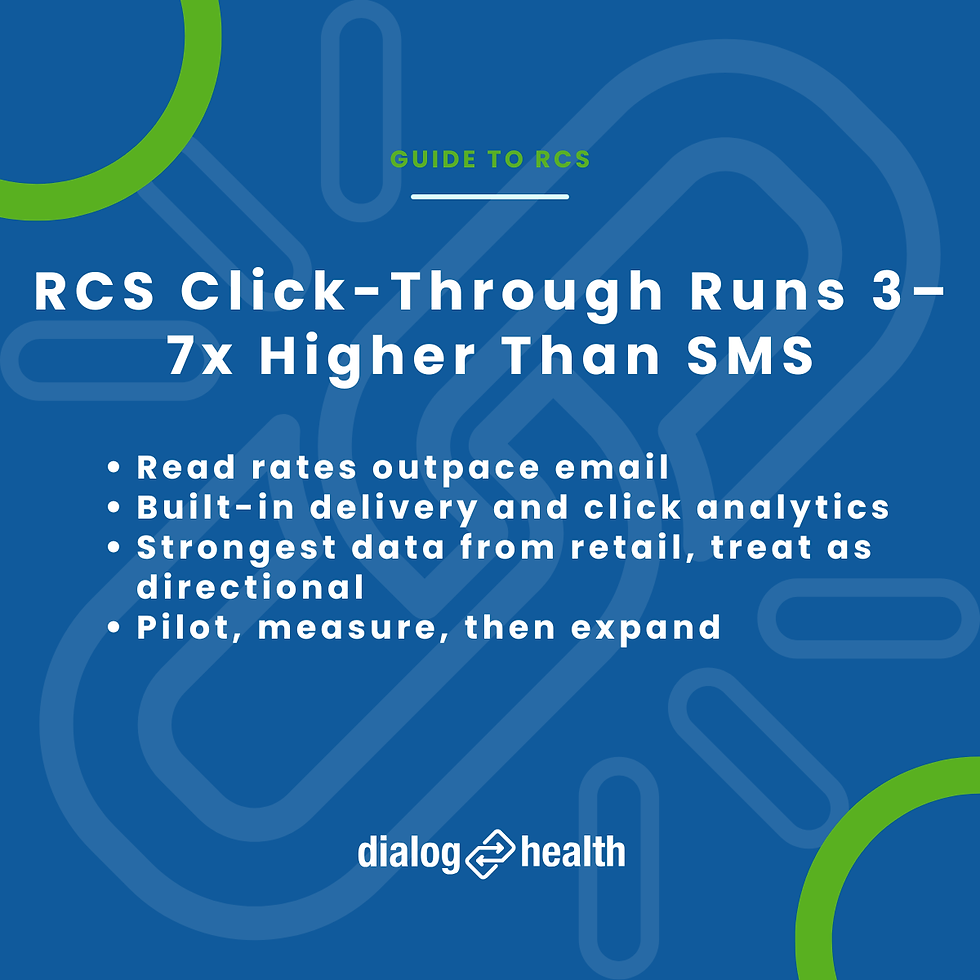
The data backs that up, with click-through rates that can run three to seven times higher than SMS and read rates that outpace email by a wide margin.
You also get something SMS never gave you: built-in delivery, read, and click analytics, so you can test what works and improve it.
Two honest caveats belong in any executive's evaluation, though.
Much of the strongest performance data comes from retail and financial-services campaigns rather than clinical settings, so treat it as directional.
And if your SMS reminder program is already strong, RCS's extra lift on something like no-shows may be modest next to its higher per-message cost.
The takeaway isn't to switch everything.
It's to pilot, measure, and expand RCS where the interactivity clearly pays for itself.
Using RCS and SMS for Staff Communication
Patient messaging gets the attention, but the same channel solves a problem inside your own walls.
Filling open shifts, pushing urgent operational updates, and reaching staff quickly all depend on a channel people actually read, and that's exactly where texting beats email and intranet portals.
The stakes are financial as much as operational.
Replacing a single staff nurse now costs around $61,110, so anything that speeds shift-fill and steadies your teams protects real money.
RCS adds branded, interactive touches here too, like one-tap shift acceptance and suggested replies, though for fast logistics plain SMS reach is often what matters most.
We've seen how much ground a texting platform can cover in a crisis.
During the early days of COVID-19, one health system used our platform to reach nearly 3,600 employees with more than 46,000 messages in about two weeks.
That's a level of speed and reliability phone trees and email chains struggle to match. See the case study.
What RCS Means for HIPAA, PHI, and Compliance
RCS for Business and PHI
This is the part you can't get wrong.
RCS for Business is not HIPAA-compliant, and Google's own terms prohibit sending protected health information through it.
That sounds like a dealbreaker, but it isn't, because most of your messaging volume isn't PHI in the first place.
Appointment dates and locations, payment links, surveys, and wellness reminders all sit comfortably outside PHI, and that's exactly where RCS shines.
Anything that does contain protected health information needs to travel through a secure, HIPAA-compliant platform whose vendor signs a Business Associate Agreement (BAA), the kind of platform Dialog Health has provided to healthcare organizations since 2011.
The cost of getting this wrong is steep, with HIPAA penalties reaching into the millions of dollars per incident.
This is the heart of the both/and approach: RCS for the rich, non-PHI majority, and a compliant texting platform for everything sensitive.
TCPA, Consent, and 10DLC
Two more rules round out the picture.
The TCPA governs consent.
The good news is that routine, healthcare-related messages, such as appointment reminders, confirmations, pre- and post-op instructions, and lab-result notifications, generally fall under a healthcare exemption.
Marketing and promotional texts are different, since those need prior express written consent and a working opt-out, with statutory damages of $500 per offending message.
Then there's 10DLC registration, a carrier-level requirement for business texting.
Register your messaging campaigns, or carriers will filter and block what you send.
None of this is a reason to avoid RCS or SMS. It's a reason to run both on a platform that handles the compliance plumbing for you.
How to Put RCS to Work Without Replacing What Already Works
You don't have to overhaul anything to start.
The cleanest on-ramp is a single, high-volume, non-PHI use case, and appointment reminders with confirm and reschedule buttons are the obvious one.
Run it as a 30-day test, RCS against your current SMS, with automatic fallback so no message goes undelivered.
Measure it against the numbers you already track, like your no-show rate, which nationally averages close to 19%.
If RCS beats SMS, expand into pre- and post-op cards, payment links, post-visit surveys, and recall campaigns, and register your verified Brand Agent to capture the trust benefit.
If the lift is marginal while the cost is higher, keep that use case on SMS and concentrate RCS where the interactivity clearly converts.
That's the whole strategy in one breath: keep the dependable reach of texting, add the richness of RCS where it earns its place, and never let protected health information leave a compliant channel.
The Compliant Texting Foundation Your RCS Strategy Needs
You just walked through what RCS can do, and the constant underneath all of it is a reliable, compliant texting foundation.
That's what Dialog Health has built for healthcare since 2011: a HIPAA-compliant, two-way platform that keeps PHI secure while your high-volume, non-PHI messaging does the heavy lifting.
The proof shows up in the numbers:
53% reduction in no-show rates
95–97% message open rates
380% increase in response with multi-language support
92% fewer post-operative phone calls
What happens next: Fill out this quick form and one of our healthcare communication experts will reach out to set up a brief 15-minute video call at your convenience.
We've done this hundreds of times with organizations like yours, and you'll leave with answers, not a sales pitch.
P.S. - Already texting patients? The 15 minutes will show you exactly where RCS can layer on top of what you already have working.


