
What Is Digital Patient Engagement and Why Does It Matter?

Key Takeaways on Digital Patient Engagement
Digital patient engagement means your organization reaches out first, in channels patients already use - it's a clinical mechanism, not a marketing metric.
The category has gone mainstream, growing about 21% a year toward an estimated $87 billion market by 2030.
Engagement pays on both sides of the ledger: the most activated patients ran 31% lower costs, and text reminders cut no-shows by 38% against a $150 billion national problem.
Patients leave over friction - 41% would switch providers after a poor digital experience, rising to 61% among the youngest adults.
Automation doubles as a workforce strategy, turning interrupt-driven phone work into batched messages and handing staff back roughly 19 hours a week.
Portals and apps store information; texting gets seen - about 98% open rates on any cell phone, with no app, login, or broadband required.
AI and value-based care will amplify whatever foundation you build - solve reach and channel strategy first.
What Does Digital Patient Engagement Actually Mean?

For most of healthcare's history, the burden of staying engaged fell on the patient.
They had to remember the appointment, decipher discharge instructions, and call during business hours.
Digital patient engagement flips that model.
It means using technology to involve patients in their own care - before, during, and between visits - with your organization reaching out first, in the channel the patient already uses, at the moment something needs to happen.
It's a family of tools, not a single product:
Patient portals and mobile apps
Text messaging and automated reminders
Telehealth and remote patient monitoring
Online self-scheduling and digital intake
Together, they form what many leaders call the digital front door.
Patient experience is how care feels, engagement is what patients actually do, and activation is whether they have the knowledge, skill, and confidence to do it.
You're buying behavior change, not software.
And the stakes are clinical, not cosmetic: an unread appointment reminder becomes a missed cancer screening, and an unviewed medication instruction becomes a readmission.
A Category That Has Moved From Pilot to Infrastructure
The market numbers tell a story about buyer behavior, not vendor revenue.
Patient engagement solutions reached roughly $27.6 billion globally in 2024 and are projected to approach $87 billion by 2030 - growth of about 21% a year.
The pandemic forced rapid adoption of remote and contactless workflows, and patient expectations never reverted once the emergency passed.
Labor scarcity turned automation from a luxury into a necessity.
Care keeps moving toward outpatient and home settings.
And payers increasingly tie revenue to outcomes and experience.
For a decision maker, that growth signals two things: your peers are actively investing, and the technology is past the early-adopter phase and into mainstream procurement.
Engaged Patients Are Healthier - and Cost Less to Treat
Most of what determines a health outcome happens outside your walls - whether the prescription gets filled, the prep instructions get followed, the follow-up appointment gets kept.
Clinicians control the care plan, but patients control its execution.
That gap is often called healthcare's last-mile problem, and engagement tools are last-mile infrastructure: the right prompt, to the right person, at the moment action is needed.
In an analysis of more than 32,000 primary care patients, those at the highest activation level ran projected costs 31% lower than those at the lowest.
Text reminders alone have cut no-show rates by 38%.
Nonadherence to medication is rarely willful defiance - it's forgetfulness, confusion about instructions, cost anxiety, and the simple absence of anyone checking in.
Each of those is a failure mode that timely, two-way communication can address.
A missed appointment is never just lost revenue, either - it breaks continuity of care and falls hardest on chronic-disease patients who depend on regular touchpoints.
The Financial Case Starts With Empty Appointment Slots

Appointment slots are perishable inventory.
Like airline seats, an unfilled slot can never be resold - yet the costs of staff, facility, and equipment run either way.
That perishability is what makes no-shows so corrosive: they cost the U.S. healthcare system around $150 billion a year, roughly $200 per missed appointment.
Prevention beats penalty here - a no-show fee recovers a fraction of the loss after the fact, while a well-timed reminder saves the slot or frees it early enough to backfill from a waitlist.
We watched this play out with one of our clients, a physician services division that switched from automated phone calls to two-way texting and dropped its collective no-show rate by 34% in six months, projecting more than $100,000 in added revenue.
Automating reminder calls can save a typical practice between $32,500 and $43,000 a year in staff time.
And the same infrastructure handles recall campaigns, digital intake, waitlist backfill, and billing notifications - each new use case at almost no extra cost.
The returns show up in hard, auditable line items: no-show rate, staff hours, slot utilization, days in accounts receivable.
You can pilot it in one department and prove it with your own data inside a quarter.
Patient Expectations Have Permanently Shifted
Your patients stopped comparing you to the hospital across town a while ago.
They compare you to the last good digital experience they had anywhere - booking a flight, ordering dinner, scheduling a haircut.
Strategists call this liquid expectations, and healthcare gets judged by that standard whether the comparison is fair or not.
41% of patients would stop going to a provider over a poor digital experience, and among 18-to-24-year-olds that figure climbs to 61% - three times the rate of the over-65 group.
Convenience runs the same way: 89% of patients want to schedule anytime through online or mobile tools.
Acquiring a new patient costs a multiple of keeping one, and a single frustrating encounter - amplified by online reviews - can steer an entire household's care decisions.
And there's a demographic conveyor belt at work: the cohorts least tolerant of analog friction are aging into their heaviest healthcare-consuming years.
Left alone, this gap widens - it doesn't close.
Why It Matters to Your Staff, Not Just Your Patients
File digital engagement under “patient experience” and you'll miss half its value.
The strongest internal champions are often operational leaders, because the same tools that engage patients remove some of the most resented work from staff plates.
Think about what your front desk does all day: ringing phones, voicemail backlogs, callback lists, confirmation calls.
All of it is synchronous work that grows in lockstep with patient volume - in a way headcount budgets never will.
Automation changes the shape of that work.
Outbound reminders run without a human touch, and inbound replies arrive as messages your team can handle in batches instead of answering live.
Real-world deployments report staff getting back around 19 hours a week from automated recall and follow-up alone.
Physician demand is projected to outstrip supply by 54,100 to 139,000 by 2033, and you cannot hire your way out of that - redesigning the workload is the durable lever.
Burnout is increasingly understood as a system property - a function of workload design and administrative burden - which makes automation a retention strategy rather than a convenience.
Where Digital Engagement Efforts Fall Short
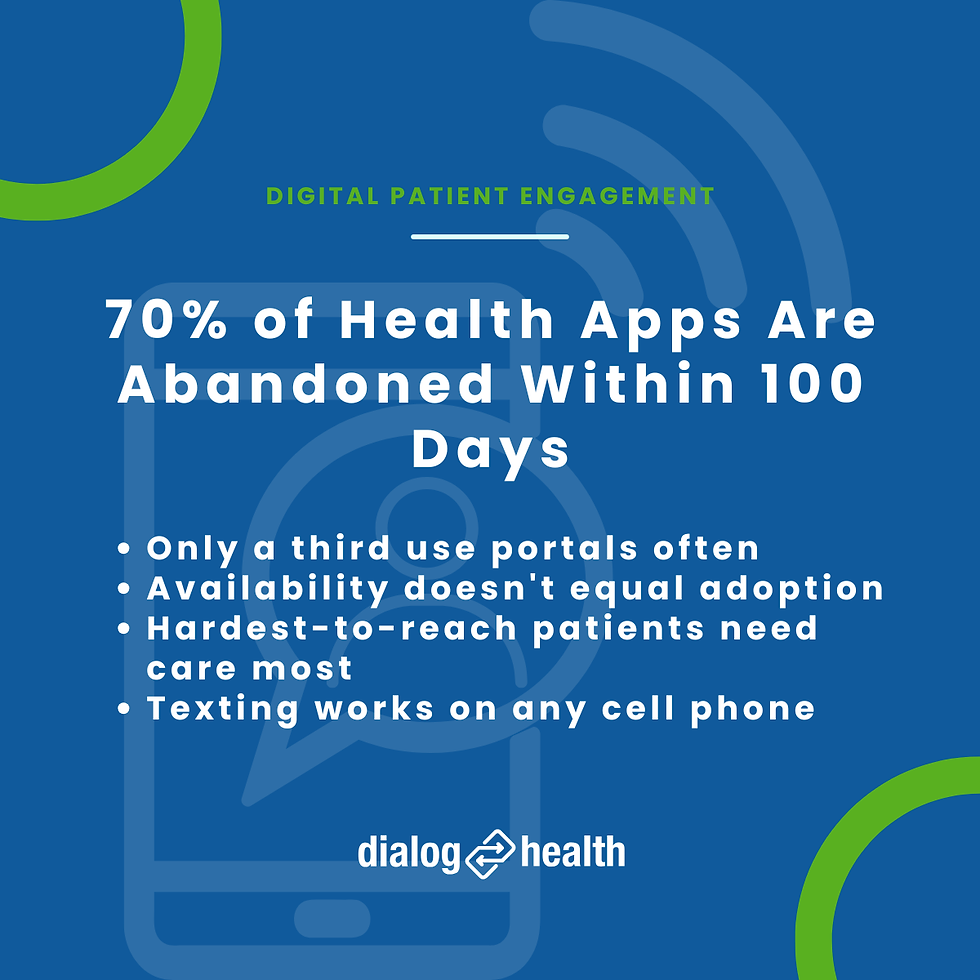
The most common failure mode in digital health is assuming availability equals adoption.
Every provider relationship spawns another account, another password, another app - and that cumulative overhead lands on the patient.
Despite years of investment, only about a third of patients use their portal frequently, and roughly 70% of people who download a health app abandon it within 100 days.
The distinction that matters is access versus use - a tool a patient technically could use, but doesn't, isn't engaging anyone.
The digital divide adds clinical risk on top: the populations hardest to reach digitally - older adults, rural residents, lower-income households, people with limited English - often carry the highest clinical need.
Two design principles follow: meet patients in channels they already use, and keep phone and in-person fallbacks so digitization expands access instead of gatekeeping it.
Language belongs there too.
One of our clients, a St. Louis health network serving a diverse metro population, turned on multi-language texting through Dialog Health and watched response rates climb from 5% to 24% - almost quadruple - while reach hit 97%.
Texting partially sidesteps the divide - it works on any cell phone, with no broadband, smartphone, or app required.
Why Texting Outperforms Portals and Apps
The simplest way to understand channel performance is as a friction hierarchy.
An app demands a download, an account, and a recurring reason to return.
A portal demands a login and the memory that it exists.
A text demands nothing - it works on every phone, needs no password, and lands in the one inbox people check all day, with no spam folder or algorithm deciding what gets seen.
The numbers follow the friction: texts get opened about 98% of the time, against roughly 20% for email, and only around 10% of patients prefer portals for provider communications.
That doesn't make portals and apps useless - they're filing cabinets, excellent at holding records and results, poor at reaching people.
Texting plays the opposite role: a trigger that reliably gets seen, then routes patients to deeper destinations - a portal link, a payment page, an intake form - when needed.
One of our case studies shows that architecture in practice: an anesthesia services organization used text messages to prompt patients to complete pre-admission paperwork in its web portal, and completion jumped from about 20% of patients to 65% - a 225% increase.
The texts didn't replace the portal.
They activated it.
Two final distinctions matter.
Two-way texting turns a notification into a conversation - patients can confirm, cancel, reschedule, or ask a question inside the same thread, turning dead-end messages into recovered appointments.
Healthcare texting also carries compliance obligations consumer marketing tools were never built for - HIPAA-appropriate content, documented opt-in and opt-out handling.
What Comes Next: AI, Value-Based Care, and Predictive Outreach
The next phase of engagement is a move from reactive to predictive.
Instead of sending every patient the same cadence, AI models flag who's likely to no-show, who's fallen out of a care plan, and who needs a human call instead of another nudge.
Adoption is already mainstream - 71% of acute-care hospitals were using predictive AI tied to their EHRs by 2024, and AI-driven engagement is now the largest segment of the market.
Value-based care is pushing in the same direction.
When revenue depends on outcomes rather than visit volume, adherence and attendance stop being nice-to-haves and become financially material, which changes how these investments get justified at the board level.
One caution.
AI is an amplifier, not a foundation.
It improves whatever communication architecture already exists, so the organizations best positioned for what's coming are the ones that have already solved reach, opt-in, and channel strategy.
The end state most analysts expect: an SMS-led digital front door with AI orchestration behind it.
Reach the 98% Who Actually Read Their Messages
You've just seen the case for digital patient engagement.
Dialog Health is a HIPAA-compliant, two-way texting platform built for healthcare: no apps, no logins, just messages patients actually read and answer.
Our clients' results mirror everything above:
34% fewer no-shows, with $100,000 in added revenue
380% increase in responses with multi-language texting
92% reduction in post-op phone calls
Fill out this quick form and one of our healthcare communication experts will reach out to schedule a brief 15-minute video call at your convenience.
We've done this hundreds of times with healthcare organizations just like yours - you'll get every answer you need, with zero pressure to buy.
P.S. Already invested in an EHR and portal? Good. We integrate with what you have, and texting makes those systems work harder.


