
9 Strategies HR Can Use to Boost Employee Engagement with Two-Way Texting

Updated: May 5
Key Takeaways on How HR Can Use Two-Way Texting to Boost Employee Engagement
80% of healthcare workers are deskless and most lack corporate email - email-first HR communication misses them.
Two-way SMS hits 98% open rates and ~45% response rates, reaching shift-based staff in minutes.
Nine high-impact HR use cases: onboarding, open enrollment, shift coverage, pulse surveys, compliance, recognition, emergencies, retention, and event turnout.
Dialog Health clients see 78% enrollment response, 83% survey participation, 99% emergency reach, and 100%+ utilization on HR portal links.
Make onboarding stick from day one

Healthcare HR is onboarding almost constantly.
With turnover averaging around 18.3% a year, a steady stream of new hires means pre-start communication is never really "done."
And yet most of it still runs through email - a channel 83% of non-desk employees don't actually have.
Text flips that problem on its head.
You can push welcome messages, training dates, document deadlines, and first-day logistics straight to the device a new hire already carries.
Because it's two-way, they can reply with questions, confirm receipt, or flag a scheduling issue before their start date - not after it.
The result is cleaner preboarding for new hires and fewer unanswered email threads for your HR team.
Turn open enrollment into a high-response moment
Open enrollment is where deskless workforces quietly break down.
Deadlines live in email, reminders pile up in an inbox nobody opens between shifts, and employees end up defaulted into plans they didn't actively choose.
Two-way texting gives you a way out of that pattern.
Across Dialog Health's client base, HR texting campaigns have driven 78% enrollment response rates and 96% employee reach, with nearly 95% of employees opting in to receive enrollment messages in the first place.
One client sent more than 20,000 enrollment texts in a single month - covering deadlines, plan-option breakdowns, and FAQ links - all through a channel employees actually check.
A Dialog Health case study that illustrates the mechanic well comes from outside healthcare: Capital Area Transit System, a transportation company with a mostly-deskless, on-the-road workforce.
Getting roughly 4,000 long-haul employees onto a new HR portal during a narrow enrollment window looked close to impossible through email alone.
A text campaign with a direct portal link produced utilization above 100% - the link was clicked more than 4,500 times - with only 6% of employees opting out.
The HR mechanics there - deskless audience, short window, benefits portal - are the same mechanics healthcare HR deals with every fall.
Fill open shifts before gaps turn into safety risks
Open shifts are one of the few communication problems where speed matters clinically, not just operationally.
An empty slot on a weekend floor is a patient-safety problem, and the traditional playbook - a manager working the phone tree - is the slowest possible way to solve it.
SMS is read within three minutes the vast majority of the time, and response rates sit around 45% for texts versus 6% for email.
That turns shift coverage into a broadcast-and-claim workflow: a nurse or CNA replies YES to the first text that fits their schedule, and the shift is filled before the next phone call would have even connected.
One healthcare staffing firm filled open shifts three times faster after switching to text-based notifications.
The financial math follows.
Each time a permanent hire picks up coverage instead of an agency body, hospitals save roughly $79,100 per travel nurse avoided - a number that compounds quickly across a large system.
Faster coverage through texting isn't a productivity story; it's a retention and cost story wearing a productivity costume.
Run pulse surveys your staff will actually answer
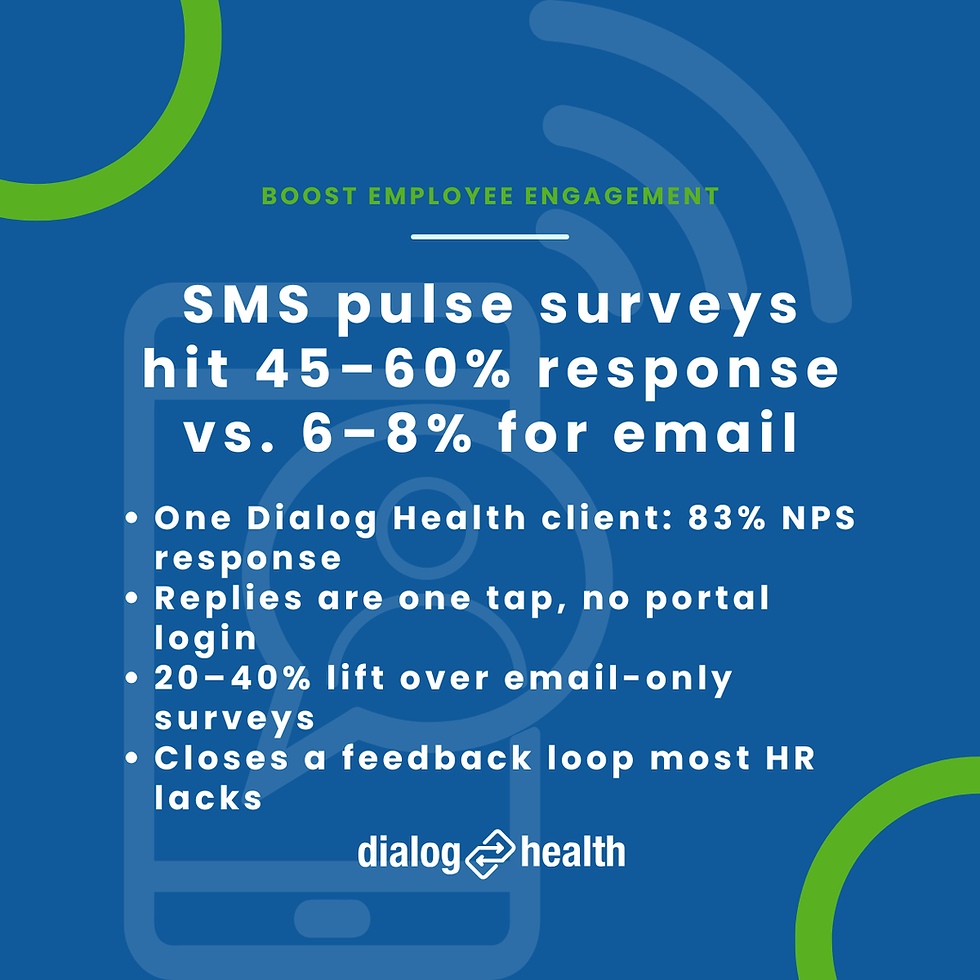
Email surveys in healthcare settle around 6–8% response rates, meaning HR rarely hears from more than a tenth of the workforce at any given moment.
Text surveys don't have that problem.
Single-question pulse checks sent via SMS consistently clear 45–60% response rates, and one Dialog Health ASC client hit an 83% NPS response rate through text alone.
A lot of that gap comes down to friction.
A text pulse is answered in one tap - reply with a number, reply YES or NO - without making anyone navigate to a portal or log in from a desk they don't sit at.
Separate research shows SMS delivery lifting participation 20–40% over email-only distribution - the difference between a representative read on staff sentiment and a self-selected sliver.
The deeper value is that two-way texting gives you a feedback loop where one didn't exist.
Roughly 38% of frontline workers say they have feedback for leadership but no channel to deliver it.
Closing that loop - even with a two-question pulse - is what turns surveys from performative into actually useful.
Keep training, certifications, and policy deadlines on track
Healthcare HR rides on an unusually dense compliance stack.
HIPAA training, OSHA, credentialing, privileging, license renewals, infection-prevention updates, emergency drills, vaccination requirements - every one of them comes with a deadline, and every missed deadline translates into either a compliance exposure or a staffing gap.
Segmented texting lets you target only the employees who haven't completed a given requirement.
That matters because message fatigue is real; HR teams can't afford to blast every nurse every Monday and still expect anyone to read the one that counts.
Dialog Health's platform supports that kind of precise segmentation alongside reply-based confirmation - something like "Reply DONE when complete" - so HR gets a clean audit trail in the same thread the reminder went out in.
It also works as a gentle pre-deadline nudge.
Renewal reminders, CE deadlines, and drill sign-ups all land on the same device employees use to complete them, which quietly compresses the lag between "reminded" and "done."
Recognize your people in the moment
One in five frontline workers says they're rarely or never recognized at work.
That's not a morale footnote - employees who feel adequately recognized are 2.8 times more likely to be engaged, and engagement loss in healthcare compounds into absenteeism, turnover, and patient-safety gaps.
Text is oddly well-suited for recognition.
A mass email about an employee milestone reads as corporate; the same note sent as a short personal text reads as human.
Birthdays, work anniversaries, shout-outs for a hard shift, small notes of thanks - they all land in a format that reads more like a real message from a real person than a newsletter blurb.
One of our clearest case studies on this is Lovelace Health System in New Mexico.
In the first two weeks of the COVID-19 response, Lovelace used the Dialog Health platform to send more than 46,000 text messages to roughly 3,600 employees - a mix of supportive notes, safety updates, and pointers to the employee assistance program.
Their HR leader directly credited the campaign with lifting staff morale during the hardest stretch of the pandemic - a result email was never going to deliver given that over 70% of Lovelace's workforce is clinical and rarely at a computer.
Reach everyone within minutes when a crisis hits

Nothing else on this list matters if your emergency communication can't land in the same hour the emergency happens.
That's where text's speed advantage stops being a convenience and starts being the plan.
Ninety-five to ninety-eight percent of texts are read within three minutes.
Mass email can't claim anything close, and phone trees are where crisis information goes to die.
One of our sharper case studies on this came out of the Oregon coast.
When a 7.0-magnitude earthquake triggered a tsunami warning near Southern Coos Hospital & Health Center in December 2024, the hospital used Dialog Health's Ad Hoc messaging to push a single, calm instruction - the facility was outside the flood zone, stay put, wait for further guidance - to every employee at once.
99% of employees were reached within minutes.
Staff stayed calm, patients stayed safe, and the operation held.
The same pattern scales across less dramatic incidents.
System outages, active-threat lockdowns, weather closures, surge-staffing calls, public-health events - all of them favor a channel that can segment clinical from administrative staff and push different instructions to each group in the same minute.
Catch flight risks early with proactive retention check-ins
An estimated 44% of healthcare turnover is considered preventable through better work-environment and communication practices.
That number is a prompt: most of the nurses who leave next quarter are reachable right now.
Organizations with strong deskless communication strategies report turnover roughly 20% lower than peers, and 63% of employees considering leaving their job cite poor internal communication as a contributing factor.
A lightweight text check-in - something as plain as "How's this month going? 1 = great, 5 = struggling" - surfaces flight risk before a resignation letter does, without asking frontline staff to schedule a meeting they don't have time for.
The quieter benefit is that a two-way thread gives employees a low-friction way to flag issues they wouldn't raise in a stand-up or a town hall.
Not every flag is preventable, but the ones that are rarely show up in an exit interview - they show up in a short text reply three months earlier, if you're listening.
Drive real turnout for town halls, wellness, and internal events
Town halls, wellness programs, CEO messages, blood drives, appreciation weeks - every internal event is only as useful as the share of staff who actually know it's happening.
That's a problem when 55% of frontline workers engage with corporate communications like town halls less than once a month through traditional channels, and only 13% of employees log into the company intranet daily.
Text promotion moves the invite to the device staff check most often.
That alone drives a visible turnout lift; combined with trackable short links, it also produces data you didn't have before - which departments clicked, which shifts didn't, which subject lines actually pulled.
Over a few cycles, that data turns event communication from a guessing exercise into a tuned channel - and the tool that started as a "reach more people" solution quietly becomes a diagnostic for how your internal communication is performing overall.
Build the HR Feedback Loop Your Frontline Actually Uses
You just saw how email-first HR misses the workforce it's meant to reach - and how two-way texting closes the gap across the employee lifecycle.
Dialog Health is built for healthcare. Our HIPAA-compliant, two-way SMS platform has helped HR teams hit:
78% open enrollment response rates and 96% employee reach
99% employee reach during emergencies
83% survey participation via text
100%+ utilization on texted HR portal links
Fill out this quick form and a healthcare communication expert will reach out to schedule a short 15-minute call at your convenience.
We've done this hundreds of times with HR leaders - no pressure, just straight answers.
You don't need to rip anything out. Dialog Health integrates with the HRIS and EHR tools you already have.


