
Why Is Effective Written Communication Important in the Healthcare Workplace?

Key Takeaways on Why Effective Written Communication is Important in the Healthcare Workplace
Communication failures show up in 40% of asserted malpractice cases and quietly drain billions from hospital margins each year.
Up to 80% of serious medical errors trace back to handoff miscommunication, making written reinforcement core safety infrastructure.
HCAHPS - and the new OAS CAHPS mandate for ASCs - tie reimbursement directly to how clearly your team communicates with patients.
No-shows, cancellations, and 30-day readmissions are downstream effects of written information that didn't land in time.
Documentation overload is one of the largest avoidable drivers of clinician burnout and turnover.
Patients have moved to two-way text as their preferred channel, while most providers still anchor on phones and portals.
Section 1557 and persistent health literacy gaps make plain-language, multilingual content a compliance and equity requirement.
Modern, HIPAA-compliant infrastructure is the only defensible answer to healthcare's record-high breach costs.
Miscommunication Carries a Massive Hidden Price Tag
The cost of poor communication in healthcare is rarely a single line on a budget.
It hides inside malpractice premiums, write-offs, redundant work, and cycle-time delays.
It only looks small until you add it up.
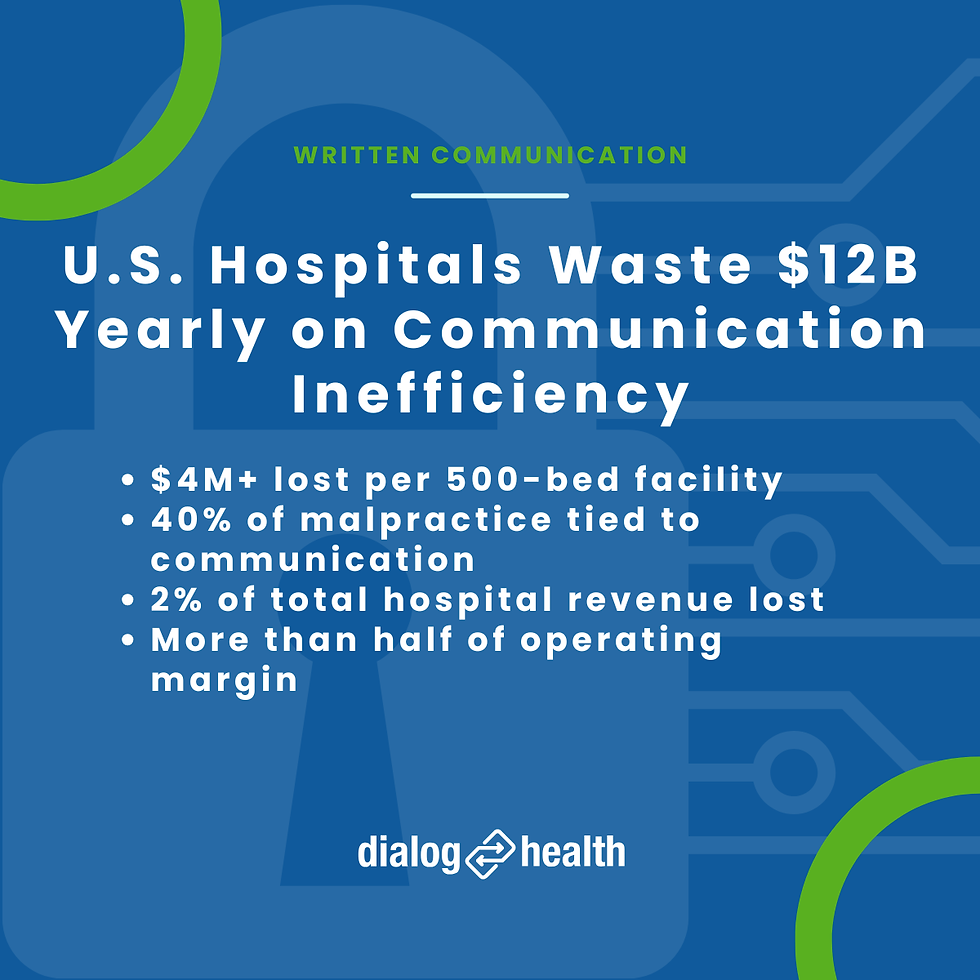
At the national level, U.S. hospitals lose an estimated $12 billion every year to communication inefficiency - roughly 2% of total revenue and more than half the operating margin most hospitals run on.
For a single 500-bed facility, that's north of $4 million annually walking out the door.
The legal picture is just as stark.
Communication breakdowns now factor into 40% of asserted malpractice cases, up from 30% the previous decade, and provider-to-patient miscommunication has become the dominant subtype.
The takeaway for any executive on a tight margin is simple - written communication is a financial control point.
Treat it as one, and the dollars spent on better infrastructure pay for themselves out of money you were already losing.
It's the Leading Root Cause of Sentinel Events and Preventable Harm
Communication keeps surfacing as the single biggest root cause of preventable harm.
Sentinel events trigger Joint Commission scrutiny, regulatory exposure, and human tragedy all at once - and they continue to climb in both volume and severity.
When investigators trace those cases back, miscommunication during patient handoffs is implicated in up to 80% of serious medical errors.
Wrong-site surgeries, delayed escalation of abnormal results, missed verifications during transitions of care - these aren't usually clinician failures.
They're the result of unstructured, time-pressured information moving between people without a shared template.
Patients absorb the same problem on the receiving end.
Most of what they hear during a hospital stay is forgotten within hours, and much of what they retain is recalled incorrectly.
That makes written reinforcement - discharge instructions, post-op care plans, medication summaries - the difference between a patient who follows their plan and a patient who returns to the ED.
If you want to defend your safety scores, this is one of the highest-leverage investments your organization can make.
HCAHPS and Value-Based Payment Hinge on How You Communicate
Patient experience used to be a marketing concern.
Today it's a payment concern.
HCAHPS measures account for 25% of the Hospital Value-Based Purchasing score, with up to 2% of Medicare payments at risk - and five of the eight HCAHPS dimensions feeding VBP through FY 2026 are explicitly communication-focused.
Communication with Nurses, Communication with Doctors, Communication about Medicines, Discharge Information, and Care Transition all measure how clearly your team conveys what the patient needs to know and do.
National top-box scores reveal pressure points.
Fewer than half of patients say their care-transition preferences were considered - meaning even high-performing systems have headroom to capture.
For ASCs, OAS CAHPS became mandatory in January 2025, and centers that fail to report face a 2-percentage-point reduction in their annual Medicare update.
That isn't a survey burden.
It's a reimbursement gate.
The communication systems you put in place now are the ones being measured next quarter.
Why Are No-Shows, Readmissions, and Cancellations a Communication Problem?

Empty appointment slots, last-minute cancellations, and avoidable readmissions share the same upstream cause.
A piece of written information either didn't reach the patient, didn't arrive in time, or wasn't understood when it did.
Missed appointments cost the U.S. healthcare system roughly $150 billion a year.
A single no-show is also a leading indicator of long-term churn.
Patients who miss once carry far higher attrition rates than patients who never miss.
Discharge communication tells the same story.
The majority of ED-discharged patients leave with comprehension gaps in at least one written-instruction domain, and most of them don't realize it.
That's how a routine discharge becomes a 30-day readmission.
ASC margins are even more sensitive, since same-day cancellations drain four to five figures from each lost case.
One of our ASC partners, AMSURG East Valley Endoscopy, replaced an inconsistent pre-op outreach process with an automated two-way texting workflow.
The result was a 66% reduction in same-day cancellations and a sharp drop in NPO non-compliance - outcomes that recovered OR throughput, protected revenue, and freed staff from manual call-down work.
The pattern repeats across settings - when written communication does its job at the right moment, the operational metrics follow.
Documentation and Inbox Overload Are Pushing Clinicians Out the Door
Workforce cost is the largest line item in most hospitals and ASCs.
The biggest avoidable driver of that cost is communication and documentation work that has scaled faster than the workforce.
Primary care physicians now spend roughly six hours of a workday inside the EHR, with another 86 minutes of after-hours "pajama time" every night.
Patient portal volume has surged since the pandemic, and most health systems can't bill for the work - so it lands as unpaid clinical labor on already overloaded clinicians.
Most hospitals lose millions of dollars a year to nurse turnover alone, with each departing staff RN representing a five-figure replacement cost.
Reducing that load is one of the few interventions that simultaneously improves retention, recruiting, productivity, and safety.
We saw this firsthand at Mountainside Medical Center, which deployed two-way texting to follow up with ED-discharged patients.
The texts let patients self-route their own needs - a nurse callback, a billing question, portal help - and staff only had to make outbound calls to 31% of discharged patients instead of all of them.
That's hours of nursing capacity returned to the floor every week from a single workflow change.
Patients Have Moved to Text - Has the Workplace Caught Up?
Patient communication preferences have moved decisively to mobile.
SMS open rates approach 98% with response rates near 45%, and most messages are read within minutes of arrival.
Smartphones are nearly universal, and a growing share of patients reach the internet only through one - often the same populations hospitals and ASCs most need to engage.
Portals require logins most patients won't perform, and phone tag remains the channel patients say they want least.
The gap between what patients prefer and what most providers deliver has become a competitive vulnerability - patients are openly willing to switch providers when their preferred channel isn't met.
Yet 88% of appointments are still scheduled by phone, and self-scheduling barely registers.
This is where two-way texting becomes core infrastructure rather than a side channel.
A HIPAA-compliant platform like Dialog Health turns one-sided blasts into a real conversation - patients can confirm, reschedule, ask questions, flag symptoms, and pay bills in a single thread.
Done well, it does what email and portals never managed - meet patients where they already check, in time to change the outcome.
Health Literacy and Language Barriers Decide Whether Instructions Land

Even the best-designed communication only works if the patient can read it, understand it, and act on it.
Only 12% of U.S. adults have proficient health literacy.
Most patient-education materials sit several grade levels above what the average reader can handle, which means default communication practices quietly under-serve the majority of patients.
Language access is the second filter.
Roughly 25.7 million U.S. adults have Limited English Proficiency, and they make medication-dosing errors at twice the rate of English-proficient patients.
The 2024 Section 1557 Final Rule now requires federally funded health programs to provide language-assistance notices in English plus the 15 most commonly spoken non-English languages by mid-2025, and bans the use of unqualified staff or family members as interpreters except in emergencies.
For decision-makers, designing written communication for low literacy and multiple languages from the start - rather than retrofitting it after a complaint - is both an equity strategy and a margin strategy.
It supports accreditation, cuts callback volume, and closes one of the most expensive comprehension gaps in healthcare.
Privacy, Cybersecurity, and Compliance Now Sit at the Heart of Communication
Healthcare has been the costliest industry on earth for data breaches for 14 consecutive years.
The 2025 average healthcare breach cost reached $7.42 million, and breaches take longer to identify and contain than in any other sector.
Standard SMS, iMessage, and WhatsApp aren't HIPAA-compliant.
Compliant texting requires AES-256 encryption, access controls, audit logs, automatic logoff, and a signed BAA - controls a consumer messaging app cannot provide.
As of 2024, CMS officially permits HIPAA-compliant texting of patient information and orders among care teams, provided a compliant platform is used.
That removes the last regulatory excuse for sticking with pagers, fax machines, and personal phones - channels that still dominate huge swaths of healthcare and create entire categories of compliance exposure.
Modernizing your communication infrastructure isn't only a productivity play.
It's how you stop inheriting the risk profile of consumer tools and start running on infrastructure built for the data healthcare actually moves.
Pair Your Communication Strategy With a Platform Built for Healthcare
You've just read why written communication touches safety, reimbursement, workforce, and revenue. Execution is where most organizations stall.
Dialog Health is a HIPAA-compliant two-way texting platform built for healthcare and trusted by Fortune 500 systems and the top-ranked U.S. hospital. Our clients regularly see:
53–66% fewer no-shows
92% fewer pre/post-op calls
82% fewer readmissions
97% reach on referral patients
Fill out this quick form and one of our healthcare communication experts will set up a brief 15-minute video call at your convenience. We've done this hundreds of times - you'll get the answers you need with no pressure.


