
10 Reasons Why Digital Patient Intake Forms Improve Patient Satisfaction

Updated: Apr 3
Key Reasons Why Digital Patient Intake Forms Improve Patient Satisfaction
Digital check-in reduces new-patient intake from 25 minutes to 5–7 minutes, cutting the wait times that frustrate 40% of patients past the 20-minute mark
81% of patients prefer digital forms over paper, and 76% would choose a provider based on the availability of online intake alone
Paper intake carries a ~20% error rate - digital drops that below 1%, reducing handwriting-related injuries and medication errors
HIPAA security protections only cover electronic health data, not paper - digital forms offer encryption, authentication, and audit trails that clipboards can't
Staff freed from manual data entry can spend more time talking to patients, with digital intake recovering 6–12 minutes per visit
88% of Americans lack proficient health literacy - digital tools like multilingual interfaces, adjustable fonts, and screen readers make intake accessible to more patients
96% of patients want upfront cost estimates - digital intake with automated insurance verification catches errors that cause up to 50% of claim denials
No More Watching the Clock in the Waiting Room
Few things frustrate patients more than showing up on time and sitting in a waiting room for 20 or 30 minutes before anyone calls their name.
A big part of that wait comes from check-in itself.
With paper forms, new patients typically spend around 25 minutes on paperwork before they're even seen.
Digital intake cuts that down to about 5 to 7 minutes - and returning patients can be done in roughly 2 minutes.
One study found that a digital check-in saving just 2.5 minutes per patient reduced the wait to see a provider by 26%.
A 5-minute saving cut it by nearly 55% - more impactful than adding an extra staff member.
When about 40% of patients start getting frustrated past the 20-minute mark, and nearly a third have walked out before being seen, those minutes matter more than most organizations realize.
Patients Should Be Able to Complete Forms on Their Own Time

One of the biggest advantages of digital intake is that patients don't have to do it in a waiting room.
They can fill out their forms at home the night before, on a lunch break, or on their phone while waiting to pick up their kids.
81% of patients prefer digital intake forms over paper clipboards, and 76% would choose one provider over another just because they offer online forms.
42% of appointments are now booked outside regular business hours, which reflects when people actually have time to handle healthcare logistics.
Organizations are making this even easier by using two-way texting to send patients direct links to their intake forms before appointments - one tap and they're done.
When digital intake is offered, patients follow through - platforms report completion rates as high as 94%, with 85% of patients fully checked in before they walk through the door.
No One Should Have to Write the Same Thing Over and Over
When patients sit down and fill out the same allergy list, medication history, and emergency contact info for the third time that year, the frustration adds up fast.
83% of patients have had to provide duplicate health information at a doctor's office, with almost three-quarters completing more than two redundant forms per visit.
That's not just an annoyance - one in five patients said the repetition makes them less likely to come back.
As one survey found, 54% of patients feel that renewing a driver's license involves less paperwork than seeing their doctor.
Digital intake connected to electronic health records changes this.
Information gets entered once and stays accessible across visits, departments, and providers.
For the 46% of patients with chronic conditions who are tired of describing the same condition at every visit, that's a meaningful difference.
Small Mistakes on Paper Can Put Patient Safety at Risk

Paper forms seem harmless, but the error rates they produce are anything but.
Manual data entry carries an error rate of roughly 20%, while digital intake brings that down to less than 1%.
1.5 million injuries happen every year because healthcare workers misread handwritten information, and medication-related handwriting errors contribute to an estimated 7,000 deaths annually.
When 20% of medication orders are illegible and nearly 80% of doctors' signatures can't be clearly read, the risk is built into the process.
Digital forms remove handwriting from the equation entirely.
They use structured fields, dropdown menus, and validation checks that catch errors before they reach the clinical team.
Hospitals that switched to computerized entry saw prescription errors drop by 66%.
90% of patients believe their lives could be at stake if their doctor doesn't have a complete and accurate medication history.
Patient Health Details Deserve Better Protection Than a Clipboard
There's something uncomfortable about patients filling out a form on a clipboard while sitting next to a stranger - their diagnoses, medications, and insurance information right there in the open.
Paper forms don't have passwords, encryption, or access controls.
HIPAA's security protections only apply to electronic health information - not to paper records.
That means the clipboard in a patient's lap has fewer federal protections than the digital version would.
Digital intake forms can be encrypted, protected behind authentication, and tracked with audit trails that show exactly who accessed the information and when.
Nearly 75% of patients are concerned about protecting their health data, and 89% consider privacy a top factor in choosing where to receive care.
53% of people now prefer to update their information through a phone, email, or portal rather than paper - patients are already looking for a more secure option.
When Staff Have Time to Actually Talk to Patients, Everything Changes
Physicians spend nearly half their office day on EHR and desk work - almost twice as much time as they spend talking to patients.
80% of patients have said their provider spent more than half the visit focused on a screen instead of on them.
Digital intake helps shift that balance.
When patient forms are already completed and loaded into the system before the visit, staff don't need to manually enter data - freeing up 6 to 12 minutes per patient.
That time goes back to the patient - to conversations, questions, and the kind of face-to-face attention that actually shapes how people feel about their care.
Research confirms that the quality of communication during a visit directly affects patient experience and how patients perceive their relationship with staff.
A Visit That Starts With a Conversation, Not Data Entry

When patients complete intake digitally before their appointment, providers can review allergies, medications, and health history in advance.
The visit starts with a conversation about the patient's health - not with someone typing while they talk.
At least 60% of practices say their digital intake solution helps them focus better on the patient experience.
When providers have time to review information beforehand, they can spend more of the appointment explaining diagnoses, discussing treatment options, and answering questions.
Patients who engage with digital intake tools are also twice as likely to express interest in scheduling preventive screenings - suggesting that when the process feels easier, people are more willing to stay proactive about their health.
Feeling in Control of the Healthcare Experience Matters
Healthcare can feel like something that happens to patients rather than something they're part of.
Digital intake gives them a small but meaningful way to take ownership of the process - reviewing their information, correcting what's wrong, confirming what's right, and submitting it on their terms.
75% of patients say digital tools are important for connecting with their healthcare providers, and research shows these tools give patients a greater sense of autonomy and voice in their care.
That sense of control has a real downstream effect.
Patients who log into engagement portals are 20% more likely to follow through on referrals, and 40% more likely if they read their care notes.
When 75% of consumers expect healthcare to be as easy to navigate as retail or banking, those expectations aren't unreasonable - they're just catching up to what other industries already offer.
Healthcare Paperwork Shouldn't Be a Barrier to Getting Care
Not every patient experiences intake forms the same way.
For the 25.7 million people in the U.S. with limited English proficiency, a form written only in English can be a wall between them and the care they need.
Only 12% of U.S. adults have proficient health literacy, meaning 88% of Americans struggle to some degree with health-related forms.
Those forms are typically written at an 11th-grade reading level - well above the national average of 8th grade.
Digital intake can bridge that gap in ways paper never could - adjustable font sizes, screen readers, voice-to-text, and multilingual interfaces make forms accessible to patients with vision impairments, reading challenges, or language differences.
Nearly 25% of insured adults have delayed or skipped care because of administrative burden alone.
Dialog Health's AI Translator supports over 130 languages with healthcare-aware translations, helping ensure that the shift to digital communication doesn't leave anyone behind.
No One Should Be Surprised by Their Medical Bill
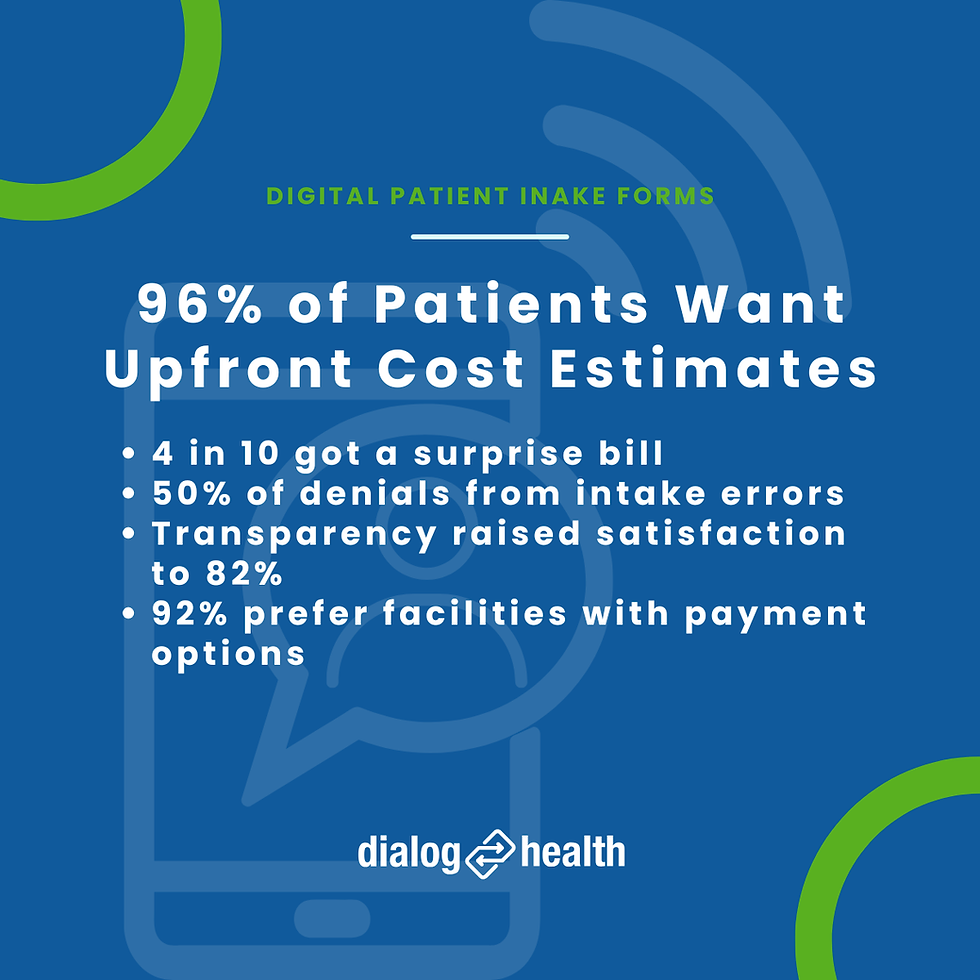
96% of patients want an accurate upfront estimate of what their care will cost, yet 4 in 10 insured adults received a surprise bill in the past year.
Two-thirds of Americans worry about affording unexpected medical bills, and 41% carry some form of medical debt.
Digital intake creates a natural moment to address this - before the appointment, not after.
Automated insurance verification at the point of intake catches eligibility issues early, preventing the billing errors that account for up to 50% of claim denials.
When patients know what to expect financially, they feel more prepared and less anxious walking in.
One health system that adopted a transparency-first approach saw patient satisfaction rise from 68% to 82% within a year.
92% of patients say they'd be more likely to return to a facility that offers flexible payment options - how organizations handle the financial side of care matters just as much as the clinical side.
Turn Patient Check-In Into a Competitive Advantage
The intake process sets the tone for everything that follows - and as the data shows, patients notice when it falls short.
Dialog Health's HIPAA-compliant, two-way texting platform helps healthcare organizations modernize how they engage with patients from the very first touchpoint.
From sending pre-visit intake form links directly to a patient's phone, to supporting 130+ languages through our AI Translator, to integrating seamlessly with your existing EHR - we make it simple for patients to complete their paperwork on their terms and arrive ready for care.
Healthcare organizations using Dialog Health have seen results like:
225% increase in pre-appointment document completion
92% reduction in pre- and post-op phone calls
83% patient survey response rate
380% increase in patient response rates with multi-language support
Ready to see how it works? Fill out this quick form and one of our healthcare communication experts will reach out to schedule a brief 15-minute video call at your convenience.
We've done this hundreds of times with healthcare organizations just like yours, and you'll get all the information you need - no pressure, no pitch.
The call is about your questions, not ours. If Dialog Health isn't the right fit, we'll tell you that too.


