Top 5 Pain Points Facing Rural and Regional U.S. Hospitals - With a Proven Solution (2026)

Updated: Mar 8
Key Pain Points for Rural and Regional U.S. Hospitals
41.2% of rural hospitals are operating at a loss, and 417 are vulnerable to closure as Medicaid cuts threaten $50.4 billion in funding over the next decade.
Rural areas have 30 physicians per 100,000 people (vs. 263 urban), with over 80% of rural census tracts designated as shortage areas.
Staff burnout and turnover cost rural hospitals disproportionately - replacing one RN averages $61,110, and professional isolation accelerates the cycle.
88% of rural leaders say their technology was designed for urban systems, and 55% plan to reassess or replace their EHR by end of 2026.
Text messaging bridges communication gaps where broadband falls short, improving medication adherence, reducing no-shows, and saving staff thousands of hours.
Financial Pressure Is Pushing Rural Hospitals Toward Closure
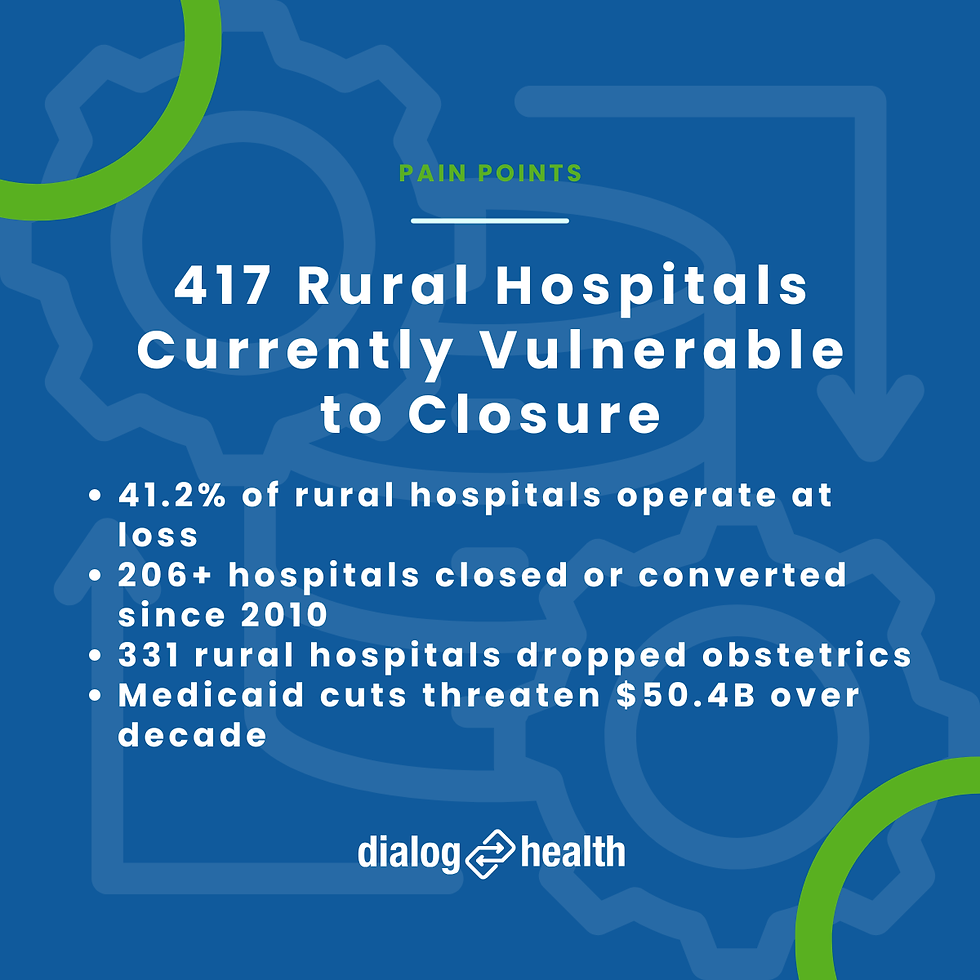
Right now, 41.2% of rural hospitals are operating in the red.
In states that haven't expanded Medicaid, the picture is worse - 52.2% are losing money, with a median operating margin of -0.7%.
The financial squeeze isn't just about thin margins, though.
It's about survival.
417 rural hospitals are currently vulnerable to closure, and more than 206 have already closed or converted since 2010.
Medicaid cuts under the One Big Beautiful Bill Act threaten to pull another $50.4 billion from rural hospital funding over the next decade, and for some facilities, Medicaid accounts for up to 63% of total revenue.
When the money dries up, services disappear with it.
Over the past decade, 331 rural hospitals dropped obstetrics, 448 stopped offering chemotherapy, and more than 300 eliminated general surgery - leaving patients to travel hours for care that used to be down the street.
Workforce Shortages Leave Rural Communities Underserved
If you run a rural hospital, you already know how hard it is to recruit.
Over 80% of rural census tracts are designated primary care shortage areas, and 89% qualify as behavioral health shortage areas.
The gap between rural and urban is staggering - rural areas have roughly 30 physicians per 100,000 people compared to 263 in urban settings.
That's an 8-to-1 disparity.
Making things worse, more than half of rural doctors are over 50, and the rural physician workforce is projected to decline 23% by 2030 as retirements outpace new hires.
The downstream effects on patients are real.
Only 4 in 10 working-age rural adults can get a same-day or next-day appointment with their primary care provider.
Meanwhile, nonmetro areas are staring at an 11% RN shortage by 2038, compared to just 2% in metro regions.
Why Burnout and Turnover Hit Rural Staff Harder
Burnout isn't just an urban hospital problem - but it plays out differently in rural settings.
Nationally, 47% of physicians report burnout symptoms, with bureaucratic tasks (62%) and excessive hours (41%) topping the list of causes.
In rural hospitals, those pressures get amplified by something urban staff rarely deal with: professional isolation.
When your facility has a handful of providers and one leaves, every remaining team member absorbs a heavier load.
That cycle feeds on itself.
Replacing a single RN now costs an average of $61,110, and every 1% shift in turnover saves or costs a hospital roughly $289,000 a year.
It's no surprise that 74% of rural hospital leaders ranked recruiting and retention as a top-two priority for 2026.
And yet, only about 40% of rural hospitals offer structured wellness or mental health programs for staff.
Outdated Technology That Wasn't Built for Rural Workflows

Most health IT systems weren't designed with rural hospitals in mind - and rural leaders know it.
In a recent survey, 88% of rural hospital leaders said vendors simply rebrand urban products as "rural-ready."
82% said they're forced to bend their workflows to fit the technology rather than the other way around.
The cost of these mismatches goes beyond frustration.
85% report that total cost of ownership is unsustainable, driven by hidden integration fees, expensive upgrades, and rising support costs.
Only 29% believe their vendors actually solve rural-specific problems, and just 22% say vendors incorporate rural feedback into product roadmaps.
On top of all that, 55% of rural and Critical Access Hospitals are planning to reassess or replace their EHR systems by the end of 2026.
Cybersecurity adds another layer of risk - 60% of rural hospitals have experienced a cyber incident in the last three years, and half cite budget limitations as the top barrier to security upgrades.
Patient Communication Gaps That Widen With Distance
When your patients are spread across large geographic areas, communication becomes a different challenge entirely.
22.3% of rural Americans lack fixed broadband coverage, compared to just 1.5% in urban areas.
That gap makes telehealth adoption difficult - 52% of rural hospital stakeholders say poor connectivity is actively holding back their digital health plans.
But even where bandwidth isn't the issue, patient engagement still lags.
Patients who receive no appointment reminder have a 23.1% no-show rate, while live reminders bring that number down to just 3%.
And 97.2% of patients prefer receiving reminders by phone call or SMS.
Text messaging, in particular, shows strong results in rural settings.
One rural hospital study found that SMS interventions significantly improved medication adherence among heart failure patients, with 92% engagement and only a 7.7% opt-out rate.
For hospitals already operating on razor-thin margins and skeleton crews, every missed appointment and every gap in follow-up care is a compounding loss.
How Dialog Health Supports Rural and Regional Hospitals
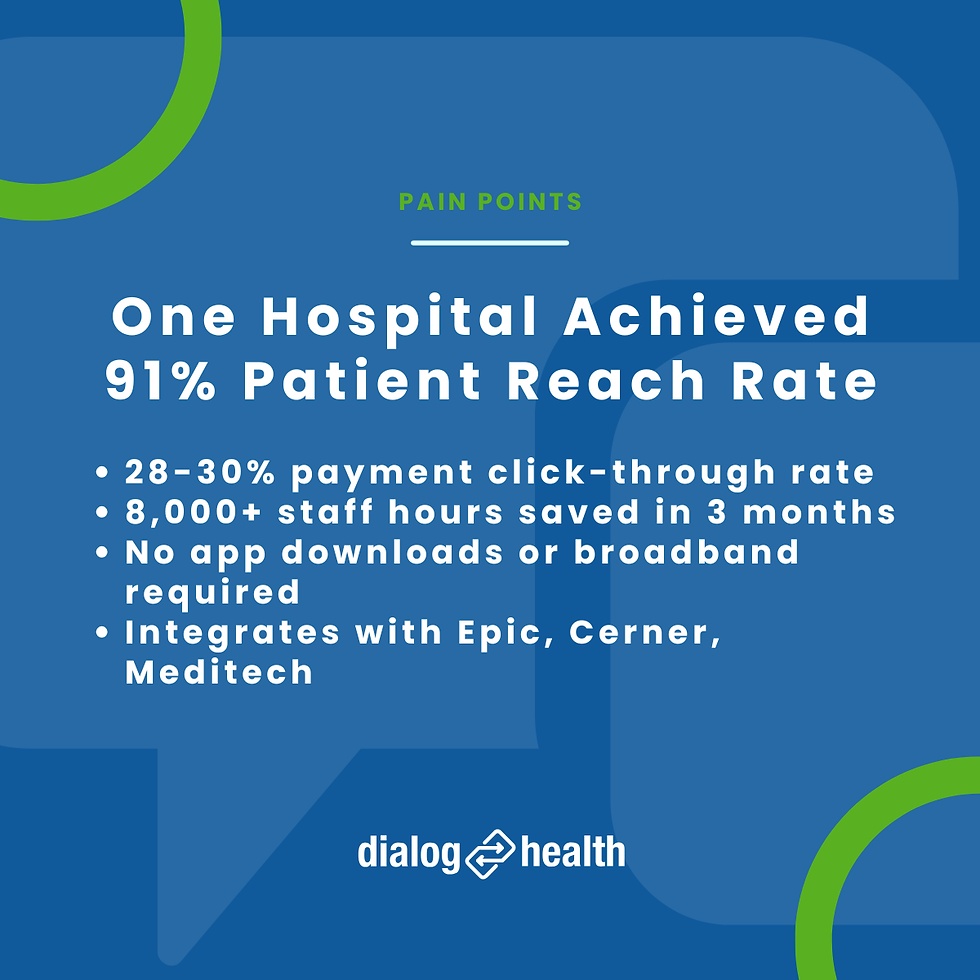
These pain points - tight budgets, short-staffed teams, outdated systems, and hard-to-reach patients - are exactly where a cloud-based, mobile-first communication platform can make a measurable difference.
Dialog Health's HIPAA-compliant two-way texting platform was built for healthcare, and it works without expensive IT infrastructure, app downloads, or broadband dependency on the patient side.
For hospitals struggling with collections, automated billing reminders and trackable payment short links have a direct impact on cash flow.
Auburn Community Hospital achieved a 91% patient reach rate and a 28-30% payment click-through rate after deploying Dialog Health's payment links - reducing manual outreach in the process.
For overstretched staff, automated workflows and two-way texting replace thousands of phone calls.
One GI center saved over 8,000 staff hours in just three months while actually improving patient and caregiver communication.
The platform integrates with existing EHR systems like Epic, Cerner, and Meditech, requires no coding to set up automated campaigns, and comes with AnalyticsPRO - real-time, auto-generated reporting that shows exactly who engaged, who didn't, and what actions were taken.
For rural hospitals that lack dedicated analytics teams, that kind of visibility is a meaningful upgrade over the status quo.
What If One Platform Could Address All Five Pain Points?
The challenges above aren't going away on their own - but the right communication tools can take real pressure off your team and your bottom line.
Dialog Health is a HIPAA-compliant two-way texting platform purpose-built for healthcare, trusted by organizations like HCA Healthcare, Ascension, and Cigna.
Here's what our clients have seen:
91% patient reach rate and 30% payment click-through for billing campaigns
92% reduction in post-operative phone calls
82% reduction in readmissions in just 90 days
8,000+ staff hours saved in a single quarter
What happens next?
Fill out this quick form and one of our healthcare communication specialists will reach out to schedule a 15-minute call.
We've done this hundreds of times with healthcare organizations just like yours, and you'll get all the information you need - no pressure, no obligation.
This isn't a sales pitch. It's a 15-minute conversation to see if Dialog Health is the right fit. Most rural hospital leaders tell us they wish they'd explored it sooner.
Addison Walling, MPH, is an Implementation Specialist at Dialog Health. Her focus is on enhancing health communication outcomes and operational efficiencies through program development and strategic planning. Building on a Master of Public Health from George Washington University, she leverages strong competencies in implementation and program design to drive measurable impact.