
The Connection Between Higher Patient Experience and Higher Profitability

Updated: Dec 10, 2025
Key Takeaways on the Connection Between Higher Patient Experience and Higher Profitability
Hospitals with "excellent" patient experience ratings achieve net margins of 4.7% compared to 1.8% for low-rated hospitals, and those delivering "superior" experience see margins 50% higher than average performers.
Better patient experience drives revenue through increased elective patient volume, stronger loyalty, and online reputation - with 93% of the financial benefit coming from market factors rather than government incentives.
Patient experience also reduces costs by lowering complaints, malpractice claims, and employee turnover while improving clinical outcomes.
Two-way texting improves experience at scale by streamlining communication across the patient journey - from scheduling and pre-registration to follow-up and billing - without adding staff workload.
Why Patient Experience Has Become a Financial Metric
For years, patient experience was treated as a "nice to have" - something that mattered for reputation but didn't show up on the balance sheet.
That's no longer the case.
Hospitals today face relentless financial pressure from reimbursement constraints, staff shortages, and the lingering effects of COVID-19.
Finding strategies that grow revenue while also reducing costs has become a top priority.
Patient experience sits at the intersection of both.
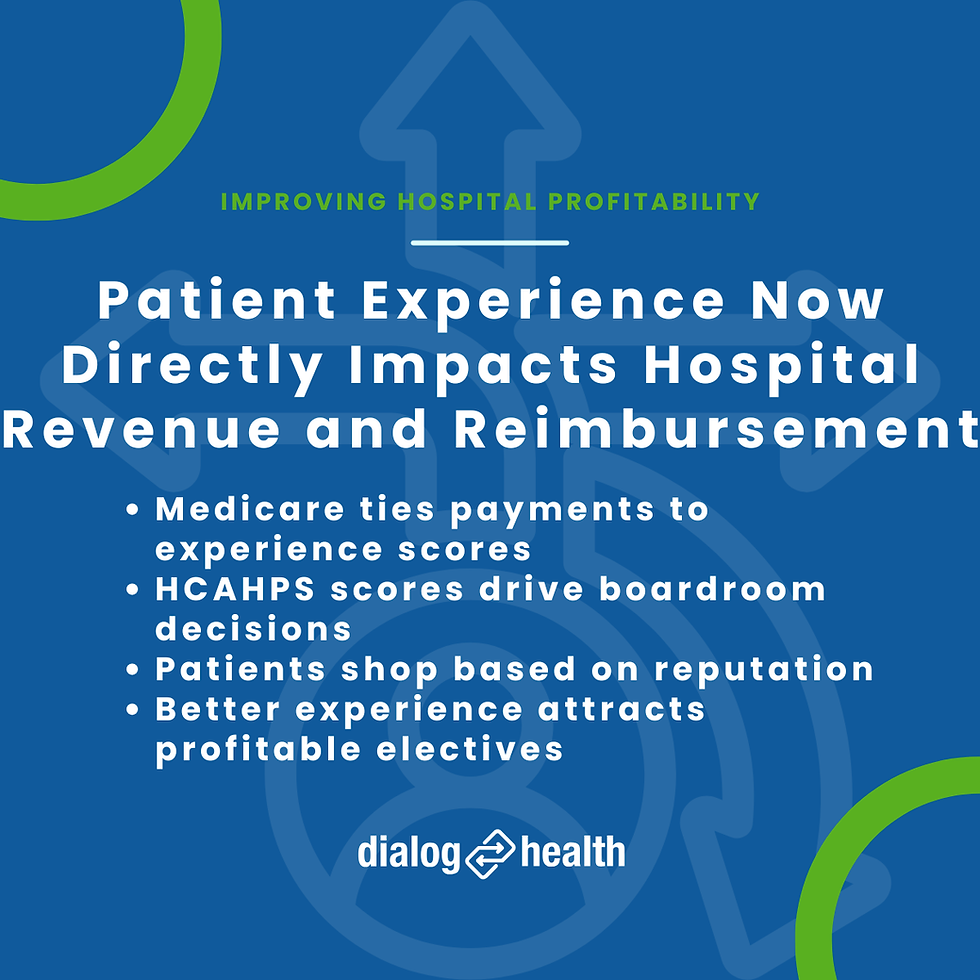
Programs like Medicare's Hospital Value-Based Purchasing (VBP) Program now tie reimbursement directly to patient-reported experience scores.
HCAHPS scores have moved from quality reports into boardroom conversations.
But government incentives are only part of the picture.
Patients themselves are shopping for care differently.
They read online reviews, ask friends for recommendations, and choose where to go for elective procedures based on reputation.
Hospitals with better experience attract more of these patients - and elective patients tend to be more profitable.
What the Research Actually Shows
The link between patient experience and profitability isn't anecdotal. Multiple studies have quantified it.
A longitudinal study of 132 Swiss hospitals (2016-2019) found that the previous year's patient experience scores were positively associated with the current year's proportion of elective patients and revenue in private hospitals, and negatively associated with costs across all hospitals.
The effects were statistically significant, even after controlling for variables like location and case mix.
In the U.S., Deloitte's analysis of HCAHPS data from 2008 to 2014 found that hospitals with "excellent" patient ratings had average net margins of 4.7%, compared to just 1.8% for hospitals with "low" ratings.
A 10 percentage point increase in top-box ratings (patients scoring the hospital 9 or 10 out of 10) was associated with a 1.4% increase in net margin and a 1.3% increase in return on assets.
These results held even after controlling for ownership, location, teaching status, and payer mix.
Other research reinforced these findings.
U.S. hospitals delivering "superior" customer experience achieved net margins 50% higher than those providing "average" experience - 6.9% versus 4.3%.
This correlation held across every hospital type: for-profit, non-profit, academic, rural, urban, stand-alone, and system-affiliated.
Perhaps most striking: the financial benefit is growing over time.
The margin increase tied to a 10% improvement in HCAHPS scores grew 70% over six years, from 1.04% in 2008 to 1.72% in 2013.
How Better Experience Drives Revenue Growth

So where does the money come from?
The short answer: elective patients and loyalty.
Elective patients are more predictable and require less upfront capacity than emergency admissions.
One study during COVID-19 found that elective surgeries generated five times higher net income than non-elective procedures.
Hospitals with better patient experience attract a higher proportion of these patients because satisfied patients return - and they recommend the hospital to others.
Deloitte's research confirmed that higher patient experience is associated with both increased revenue and increased expenses per patient day.
But the revenue effect is stronger. In other words, you spend more to deliver better experience, but you earn back more than you spend.
Online reputation plays a role here too.
Patients increasingly rely on reviews when choosing where to seek care.
Hospitals with high ratings attract new patients through visibility alone.
One detail worth noting: Medicare VBP incentives account for only about 7% of the association between patient experience and financial performance.
The remaining 93% comes from market-driven factors - loyalty, referrals, and reputation.
This means the business case for patient experience doesn't depend on government programs.
The Cost Reduction Side of the Equation
Revenue isn't the only lever.
Better patient experience also correlates with lower operating costs.
Fewer complaints mean fewer resources spent on service recovery.
Fewer malpractice claims and liability cases mean lower legal expenses.
Better experience is also linked to improved clinical effectiveness and patient safety, which reduces costs tied to adverse events and readmissions.
There's an employee angle here too.
Research shows that employee satisfaction correlates with patient experience.
Hospitals with engaged staff see fewer medical errors, higher quality of care, and lower turnover - all of which drive costs down.
In concrete terms, a hospital system with $2 billion in revenue would need to cut 460 jobs to achieve the same 2.3% margin improvement that better patient experience delivers through revenue growth.
Improving experience is a more sustainable path than cutting headcount.
Where Two-Way Texting Fits In
If patient experience drives profitability, the next question is practical: how do you improve it at scale without overwhelming your staff?
Two-way texting is one answer.
It touches nearly every stage of the patient journey: appointment reminders, prep instructions, pre-registration links, arrival procedures, post-visit follow-up, billing, and satisfaction surveys.
Each of these touchpoints is an opportunity to either strengthen or weaken the patient's perception of your organization.
Deloitte found that patient experience scores related to nurse-patient interactions had the strongest association with financial outcomes.
Two-way texting extends that communication beyond the hospital walls - keeping patients informed and engaged before and after their visit.
From an operational standpoint, trackable links eliminate manual follow-up calls.
Staff can see in real time who clicked a link and who didn't, allowing them to focus outreach where it's actually needed.
This reduces workload while improving engagement.
The revenue implications are direct: online scheduling links increase appointment volume, pre-registration links reduce check-in friction, payment reminders with links accelerate collections, and recall campaigns bring patients back for preventive care.
Each of these moves the needle on both experience and revenue.
Making the Investment Case
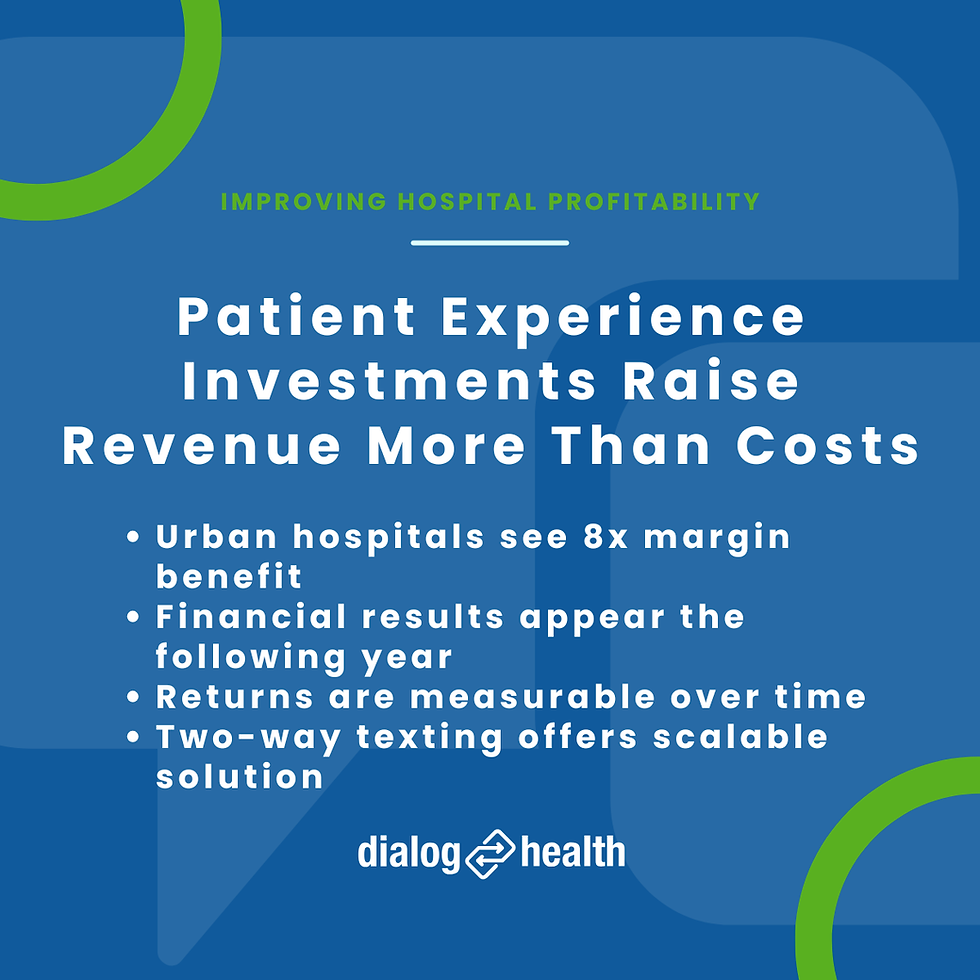
The research points to a clear pattern: investments in patient experience raise costs, but they raise revenue more.
The net effect is higher margins.
Urban hospitals see roughly eight times the margin benefit from superior patient experience compared to rural facilities, likely because higher patient volumes amplify the return.
But the effect exists across the board.
One important nuance: improvements in patient experience tend to show up in financial results the following year, not immediately.
This means the investment requires patience - but the returns are measurable.
Given the market's ongoing shift toward patient-centered care and the growing weight payers place on experience scores, tools that enhance communication and engagement deserve serious consideration.
Two-way texting is one of the more practical options available - scalable, measurable, and aligned with how patients already prefer to communicate.
Ready to Make Patient Communication a Revenue Driver?
The research is clear: better patient experience leads to higher margins.
But improving communication across every touchpoint - without adding staff workload - requires the right tool.
Dialog Health's HIPAA-compliant two-way texting platform helps healthcare organizations do exactly that.
The results speak for themselves:
53% reduction in no-show rates
82% reduction in readmissions in just 90 days
92% reduction in post-operative phone calls
54% increase in cash flow with RCM texting
Curious whether it fits your organization?
Fill out this quick form and one of our healthcare communication experts will reach out to schedule a brief 15-minute call at your convenience.
No pressure - just a straightforward conversation about your goals.


